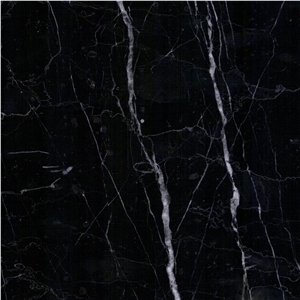
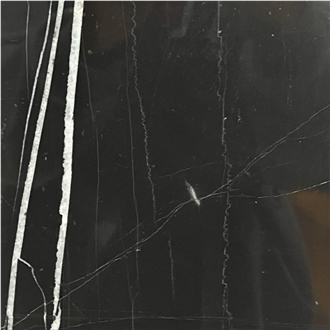
Argos Black Breccia Marble features a deep black to dark charcoal background, creating a dramatic and sophisticated appearance. The dark base is contrasted by striking white and light grey branching veins that resemble cobwebs or intricate natural networks. Subtle variations in grey tones add depth and visual complexity, making each slab distinctive.
Texture & Structure
A natural brecciated marble characterized by a dense carbonate structure with irregularly distributed calcite and quartz veins. Its surface can be processed to achieve polished, honed, or other decorative finishes. The contrasting mineral veins create a distinctive visual texture against the predominantly dark background.
Pattern
The defining feature is its irregular, interconnected white and grey veining, forming branching, web-like patterns across the dark matrix. The veins vary in thickness and direction, creating a dramatic network resembling fractured or interconnected mineral formations. Each block and slab displays natural variations in vein density and distribution.
Technical Characteristics
|
Property
|
Test Result
|
|
Bulk Density
|
2,790 kg/m³
|
|
Water Absorption
|
2.20% by volume
|
|
Flexural Strength
|
8.4 MPa
|
|
Compressive Strength
|
184.0 MPa
|
Hardness
Argos Black Breccia Marble is a calcite-dominant natural stone with a typical Mohs hardness of approximately 3. Its dense structure and reported compressive strength of 184 MPa provide good resistance to compressive loads. However, its surface can be susceptible to scratching, abrasion, and acid etching. Quartz-bearing veins may exhibit locally different hardness characteristics.
Chemical & Mineralogical Composition
The stone is primarily composed of carbonate minerals, with contrasting silicate and carbonate mineral veins.
-
Calcite (CaCO₃): Principal carbonate mineral forming the marble matrix.
-
Quartz (SiO₂): May occur in white or grey mineral veins.
-
Dolomite (CaMg(CO₃)₂): May be present in variable proportions.
-
Carbonaceous Minerals: May contribute to the dark background coloration.
-
Other Accessory Minerals: Minor mineral phases may occur depending on the quarry section.
Note: Exact chemical and mineralogical percentages by weight have not been provided. The above composition is descriptive and should not be treated as a verified laboratory analysis.
Usage
Suitable for premium interior architectural and decorative applications, including flooring, wall cladding, feature walls, countertops, vanity tops, reception desks, fireplace surrounds, staircases, decorative panels, and luxury furniture. Its dramatic black background and contrasting white veining make it particularly suitable for statement installations in hotels, commercial interiors, luxury residences, and contemporary architectural projects.
Maintenance
Argos Black Breccia Marble should be treated with a suitable penetrating stone sealer to help reduce staining and moisture penetration. Clean regularly using a pH-neutral stone cleaner and a soft cloth or mop. Avoid acidic substances such as vinegar, lemon juice, and acidic cleaning products, as they can etch the calcite surface. Wipe spills promptly, particularly oils, wine, and acidic liquids. Periodic resealing is recommended depending on the application, traffic, and exposure conditions. For countertops and frequently used surfaces, use protective mats and avoid direct cutting or placing hot cookware on the stone.


 Greece


 10YR

 China

 Spain

 Italy
 Tunisia

 Pakistan

 France


 Turkey


