


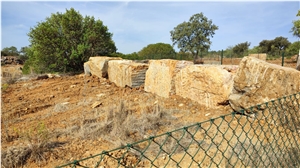
Brecha Do Algarve Breccia Marble Blocks
 Portugal

 Portugal (Sao Brás de Alportel, Faro, Algarve)
Brecha do Algarve Marble, also known as the Algarve Breccia, is a distinctive type of sedimentary rock found in the region of São Brás de Alportel, Faro, Algarve, Portugal. This limestone is characterized by its unique salmon red-greyish brown coloration, which makes it visually distinct and aesthetically appealing.
Key characteristics of the Brecha do Algarve Marble:
Color: The dominant background color of this limestone is a salmon-red hue with greyish-brown variations. This coloration adds to the stone's visual appeal and can make it a popular choice for construction and architectural purposes.
Hardness: It possesses a medium hardness, which means it is durable and suitable for various applications. The medium hardness allows it to be cut and shaped into different forms with relative ease, making it a versatile building material.
Grain Size: The limestone typically exhibits a medium to gross grain structure. The varying grain sizes may contribute to its unique appearance and texture.
Non-Uniform Bottom: The bottom surface of the Brecha do Algarve Marble is non-uniform, meaning it does not have a perfectly even or smooth texture. This can be both an aesthetic feature and a functional one, adding character to the stone and potentially enhancing its slip resistance when used for flooring.
Calcite Deposits: Large areas of calcite deposits are commonly found within this stone. Calcite is a mineral that is often associated with limestone, and its presence can create interesting patterns and variations within the stone, further contributing to its visual appeal.
Origin: This stone is specifically extracted in the Algarve region, near São Brás de Alportel in Faro, Portugal. The local geological conditions have contributed to the development of this unique stone.
The Brecha do Algarve Marble is used for a variety of architectural and construction purposes, including interior and exterior applications such as flooring, cladding, countertops, and decorative elements. Its distinctive color, grain structure, and the presence of calcite deposits make it a sought-after material for enhancing the aesthetics of buildings and landscapes in the Algarve region and beyond.

 Italy

 Turkey

Turkey

Italy

 Spain

 India

 Iran

Iran

 Myanmar

Myanmar

 China

China
