Post Your Needs

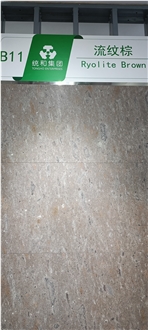
China Brown Rhyolite

Rhyolite

China

About

Item Details

Material Type:
Rhyolite
Origin:
China
Recommended Usage:
Monuments, building stone, ornamental stone, stairs, interior, exterior wall and floor applications, mosaic, wall panels, reliefs, window sills, balustrades, columns, wall and pool copings, pool pavers, sculptures, fireplaces, cobbles, pavers, curbstone
Additional Names:
Rhyolite Brown Flow, Flow Vein Brown Rhyolite, Flow-Banded Brown Rhyolite, in China stone market:流纹棕(Liú Wén Zōng)
Finished Surface:
Polished,Flamed,Bush Hammered,Tumbled,Brushed,Honed,Split,Machine Cut,Natural Surface,Sandblasted,Acid Washing,Combed,Leathered,Water Jet,Filled,Chiseled,Pickling

Testing

Water Absorption:
0.35% – 0.65%
Density:
2500 – 2600 Kg/m³
Flexural Strength:
12 – 15 MPa
Compressive Strength:
120 – 150 MPa

Description

China Brown Rhyolite is a volcanic-origin natural stone characterized by its pale brown to earth grey base, adorned with darker, fluid-like flow patterns resulting from ancient lava movement. It is a fine- to medium-grained stone with a unique visual depth and natural rustic elegance, making it highly desirable for both interior and exterior architectural applications.

Texture & Pattern

  • Grain: Fine to medium crystalline texture
  • Texture: Slightly porous with a soft matte feel in natural finish
  • Pattern: Linear or wavy dark brown-grey bands caused by lava flow layering
  • Appearance: Earthy and organic with natural mineral shimmer in light

Physical & Mechanical Properties

  • Water Absorption .... 0.35% – 0.65%
  • Density .... 2.50 – 2.60 g/cm³
  • Compressive Strength .... 120 – 150 MPa
  • Flexural Strength .... 12 – 15 MPa
  • Mohs Hardness .... 6 – 7
  • Abrasion Resistance .... Moderate to high
  • Porosity .... Moderate

Chemical Composition (% by Weight)

  • SiO2 (Silica) .... 70 – 78%
  • Al2O3 (Alumina) .... 12 – 14%
  • Fe2O3 (Iron Oxide) .... 2 – 4%
  • K2O + Na₂O .... 4 – 6%
  • CaO .... < 1%
  • MgO .... < 1%

Mineral Composition (% by Weight)

  • Quartz .... 45 – 55%
  • Feldspar (Plagioclase + Orthoclase) .... 35 – 40%
  • Biotite/Muscovite .... 5 – 8%
  • Other accessory minerals .... < 5%

Surface Finish Options

  • Polished .... Enhances color and pattern; for interiors, wall cladding, vanities
  • Honed .... Matte smooth; floors, kitchens, and bathrooms
  • Leathered .... Soft textured; countertops, vanities
  • Bush-Hammered .... Coarse anti-slip; outdoor paving and steps
  • Flamed .... Rough, non-slip; ideal for outdoor facades, terraces
  • Natural Split .... Rustic and raw; often used in wall cladding or landscaping

Cutting Sizes

Slabs:

  • Standard: 240×120 cm to 300×180 cm (94”×47” to 118”×71”)
  • Thickness: 2 cm (3/4"), 3 cm (1-1/4"), custom upon request

Tiles:

  • 30×30 cm (12"×12")
  • 60×30 cm (24"×12")
  • 60×60 cm (24"×24")
  • 80×40 cm (32"×16")
  • Custom sizes available for projects

Usage Applications

  • Interior flooring and wall cladding
  • Facades and exterior paving
  • Fireplace surrounds, countertops, vanities
  • Landscape architecture and garden features
  • Urban design (benches, stairs, planters, etc.)

Maintenance Guidelines

Sealing: Recommended, especially for exterior or wet-area use

Cleaning: Use pH-neutral stone cleaner; avoid acidic or abrasive products

Upkeep: Low maintenance once sealed; periodic resealing (every 1–2 years)

FAQ

Do fruit juices stain the surface of China Brown Rhyolite floor tiles?

Fruit juices can potentially stain the surface of China Brown Rhyolite floor tiles if the spill is not promptly cleaned up. The acidity and pigmentation in some fruit juices can cause staining on natural stone surfaces if left to sit for an extended period of time. It is recommended to wipe up any spills immediately and clean the area with a gentle stone cleaner to prevent staining.

Is 3cm thick China Brown Rhyolite durable enough for use as walkway pavers?

China Brown Rhyolite is a type of igneous rock that is known for being durable and strong. Being 3cm thick, it should be suitable for use as walkway pavers in most applications. It is important to consider the amount of foot traffic and weight that the pavers will be subjected to, as well as the overall design and installation of the walkway. If properly installed and maintained, 3cm thick China Brown Rhyolite should be durable enough for use as walkway pavers.

Does the surface of China Brown Rhyolite scratch easily?

The surface of China Brown Rhyolite is relatively scratch-resistant, as it is a type of volcanic rock that is known for its hardness and durability. However, like any natural stone, it may still be susceptible to scratching under certain conditions, especially if it comes into contact with sharp or abrasive objects. Regular care and maintenance, such as using coasters or placemats, can help prevent scratching and keep the surface looking its best.

Can China Brown Rhyolite be used for pool coping?

Yes, China Brown Rhyolite can be used for pool coping. Rhyolite is a durable and dense volcanic stone that is resistant to water and weathering, making it a good choice for pool coping which is constantly exposed to moisture. The natural earthy brown color of China Brown Rhyolite can also lend a beautiful and organic look to the pool design. Just be sure to properly seal the stone to protect it from potential staining or damage from pool chemicals.

Can China Brown Rhyolite be used for street kerbstones?

Yes, China Brown Rhyolite can be used for street kerbstones. Rhyolite is a durable and hardwearing stone that is suitable for outdoor applications such as kerbstones. Its natural beauty and unique color variations make it a popular choice for landscaping and hardscaping projects. When properly sourced and installed, China Brown Rhyolite can provide an attractive and long-lasting solution for street kerbstones.

Can China Brown Rhyolite be used for kitchen countertop?

Yes, China Brown Rhyolite can be used for kitchen countertops. Rhyolite is a durable and heat-resistant rock, making it suitable for use in a high-traffic area like a kitchen. However, it is important to properly seal and maintain the surface to protect it from stains and scratches. It is always recommended to consult with a professional stone fabricator to ensure that the material is suitable for your specific needs and to properly install and maintain the countertop.

How can I repair the scratched surface of the China Brown Rhyolite steps?

To repair the scratched surface of your China Brown Rhyolite steps, you can follow these steps: 1. Clean the surface: Start by cleaning the steps with a mild soap and water solution to remove any dirt or debris that may be on the surface. 2. Sand the scratches: Use fine-grit sandpaper to gently sand the scratched areas of the steps. Be sure to sand in the direction of the grain of the stone to avoid causing further damage. 3. Apply a stone polish: Once the scratches have been sanded out, apply a stone polish to the steps to restore the shine and color of the stone. Be sure to follow the manufacturers instructions for the specific product you are using. 4. Seal the surface: To protect the repaired area and prevent future scratches, consider applying a sealer to the steps. This will help to maintain the beauty of the stone and make it easier to clean and maintain. By following these steps, you should be able to repair the scratched surface of your China Brown Rhyolite steps and restore them to their original beauty.

Is China Brown Rhyolite a suitable choice for gravestones?

Yes, China Brown Rhyolite is a suitable choice for gravestones. Rhyolite is a durable and strong natural stone that can withstand the outdoor elements and is resistant to weathering and fading. The brown color of China Brown Rhyolite can provide a unique and attractive appearance for gravestones. Additionally, it is relatively easy to maintain and can be polished to enhance its natural beauty.

Products & Prices

Hot Rhyolite

New Rhyolite

Post Your Request

The request includes:
  1. surface finished, size
  2. quantity required