


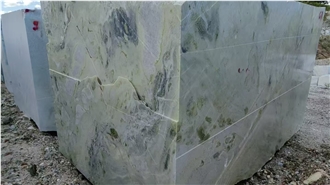
Emerald Green Marble Blocks
 3YR

 India


 Iran
Emerald Serpentine Marble, commercially known in the Chinese stone market as 绿野仙踪 (Lǜ Yě Xiān Zōng), is an exotic green natural stone from Iran. It features a rich forest-green to dark olive-green background accented by striking yellowish-green, moss-green, and golden-green mineral formations. Its intensely wavy, irregular, and interconnected patterns create a dramatic appearance reminiscent of a lush forest landscape.
The stone's distinctive serpentine-like structure, rich natural coloration, and excellent decorative appeal make it particularly attractive for luxury interior design and high-end architectural applications.
Base Color: Deep forest green, dark olive green, and emerald green.
Secondary Colors: Moss green, yellowish-green, chartreuse, and subtle golden-green tones.
Veining: Irregular, elongated, dark green to nearly black interconnected veins.
Pattern: Strongly directional, swirling, folded, and wavy mineral formations with irregular elongated patches of lighter green.
Color Variation: Moderate to high, with varying concentrations of dark and light green minerals across individual slabs.
Overall Appearance: Exotic, dramatic, richly textured, and luxurious.
Grain Size: Visually fine-to-medium-grained.
Texture: Compact-looking, irregularly patterned crystalline structure.
Structure: Pronounced flowing, folded, and elongated mineral formations characteristic of serpentine-rich decorative stones.
Polishing Ability: The photographed slab displays a highly polished, reflective surface that enhances the contrast between its dark and yellowish-green mineral formations.
Surface Finish Options: Polished, honed, brushed, leathered, and sawn cut, subject to material suitability.
Serpentine-rich stones can exhibit different physical and mechanical properties from conventional calcitic marbles due to their magnesium silicate mineral composition.
If petrographic analysis confirms its serpentine-rich composition, the stone would be expected to contain hydrated magnesium silicate minerals, potentially accompanied by iron-bearing minerals and minor carbonate constituents.
Potential Mineralogical Constituents:
Antigorite: Magnesium-rich serpentine mineral.
Lizardite: Serpentine-group mineral.
Chlorite: Potential contributor to green coloration.
Magnetite (Fe₃O₄): Potential contributor to darker mineral formations.
Chromite (FeCr₂O₄): Possible accessory mineral.
Calcite (CaCO₃): Possible constituent of carbonate-rich veins.
Magnesite (MgCO₃): Potential secondary carbonate mineral.
Talc: Possible secondary mineral.
Chemical Composition:
The theoretical chemical composition of pure magnesium serpentine, Mg₃Si₂O₅(OH)₄, expressed as oxide equivalents by weight:
Magnesium Oxide (MgO): 43.63%
Silicon Dioxide (SiO₂): 43.36%
Structurally Bound Water (H₂O): 13.01%
These percentages represent the theoretical composition of pure magnesium serpentine, not the actual chemical test results of Emerald Serpentine Marble. Natural material may additionally contain iron, aluminum, calcium, chromium, and nickel-bearing compounds.
Country of Origin: Iran
Commercial Name: Emerald Serpentine Marble
Additional Name: Emerald Serpentine
Chinese Commercial Name: 绿野仙踪 (Lǜ Yě Xiān Zōng)
Literal English Translation: The Wizard of Oz
Commercial Classification: Marble
Probable Geological Classification: Serpentinite or serpentine-rich metamorphic rock
Primary Color: Green
Secondary Colors: Dark green, olive green, yellowish-green, and golden green
Exact Quarry Location: Not confirmed
Luxury interior wall cladding
Bookmatched feature walls
Decorative wall panels
Interior flooring
Bathroom vanity tops
Kitchen countertops and islands, subject to suitability testing
Reception desks and bar counters
Fireplace surrounds and mantels
Decorative furniture and tabletops
Staircases and risers
Window sills and door surrounds
Columns and ornamental stonework
Mosaics and waterjet decorative inlays
Artistic sculptures and decorative objects
Luxury hotels, villas, restaurants, and commercial interiors
Its pronounced directional patterns make Emerald Serpentine Marble particularly attractive for large-format slabs, bookmatched compositions, and continuous decorative wall installations.
Exterior applications should be evaluated according to frost resistance, weathering resistance, and mechanical test results.
Clean regularly using a soft cloth and pH-neutral natural stone cleaner.
Apply a compatible penetrating stone sealer where necessary.
Avoid acidic cleaning products and aggressive chemicals, particularly where carbonate minerals are present.
Remove spills promptly to prevent staining and discoloration.
Avoid abrasive cleaning pads that may scratch softer mineral formations.
Use cutting boards, coasters, and protective heat-resistant pads on countertops.
Evaluate moisture sensitivity before installation, as some serpentine-rich stones may experience warping when installed with water-based adhesives.
Use professional wet-cutting methods and appropriate dust-control measures during fabrication.
Confirm mineralogical composition, including the potential presence of asbestiform minerals, before industrial processing.

India

India

 Ireland

 Italy

India

India

 Turkey

 Greece

Iran

Turkey

Turkey

Turkey
 China