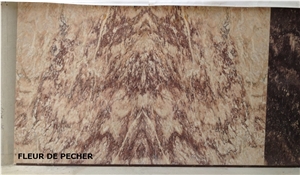
Fleur De Pecher Marble is a distinctive Italian breccia marble characterized by irregular fragments in shades of violet, purple, red, pink, flesh, and occasional pale grey, set within a contrasting carbonate matrix. The combination of warm and cool tones gives the stone a highly decorative and luxurious appearance.
Texture & Structure:
The marble has a fine- to medium-grained crystalline structure with a dense, compact character. Its brecciated structure consists of irregular angular to sub-angular marble fragments naturally cemented within a fine-grained carbonate matrix. Polishing enhances the depth and color contrast between the individual fragments and the surrounding matrix.
Pattern & Veining:
Fleur De Pecher is defined by its highly irregular breccia pattern rather than conventional linear veining. Violet, red, pink, and flesh-colored fragments form a fragmented, mosaic-like composition, often separated by contrasting white, pale grey, or darker purple matrix and fine mineral seams. The arrangement varies considerably from block to block, producing highly individual slab patterns.
Technical Characteristics (Indicative):
- Water Absorption: 0.20–0.70% by weight
- Density: 2680–2710 kg/m³
- Flexural Strength: 9–12 MPa
- Compressive Strength: 80–100 MPa
- Open Porosity: 0.20–1.00% by volume
- Hardness: 3–4 Mohs
Mineral Composition (Indicative, % by weight):
- Calcite: 88–96%
- Dolomite: 1–5%
- Quartz: 0–2%
- Mica/Phyllosilicates: 0–2%
- Clay Minerals: 0–2%
- Iron-Bearing and Accessory Minerals: 0–2%
Chemical Composition (Indicative, % by weight):
- CaCO₃: 86–95%
- MgCO₃: 1–4%
- SiO₂: 0.5–2.5%
- Al₂O₃: 0.1–1.5%
- Fe₂O₃: 0.1–1.5%
- Other Oxides: 0–2%
Usage:
Suitable for luxury interior flooring, wall cladding, feature walls, fireplace surrounds, columns, stairs, vanity tops, countertops, bathroom walls, reception areas, tabletops, furniture, decorative panels, architectural details, monuments, and other high-end ornamental applications. Due to its distinctive brecciated pattern and historical use in prestigious interiors, it is particularly suitable for statement architectural and decorative elements.
Finishes:
Polished, honed, brushed, sanded, sawn, tumbled, and other custom finishes.
Maintenance:
Clean with a pH-neutral stone cleaner and a soft cloth or mop. Avoid vinegar, lemon juice, acidic cleaners, abrasive powders, and other aggressive cleaning products, as marble is susceptible to acid etching and scratching. Seal according to the stone's porosity and intended application, particularly for countertops, vanities, and bathroom surfaces. Wipe spills promptly and use protective pads on furniture and countertop applications. For exterior applications, suitability should be evaluated according to local climate, freeze-thaw exposure, and the specific quarry material.


 Italy

 13YR

 Morocco

 France



 Turkey



 Spain

 India

 Iran


 Myanmar


 China
