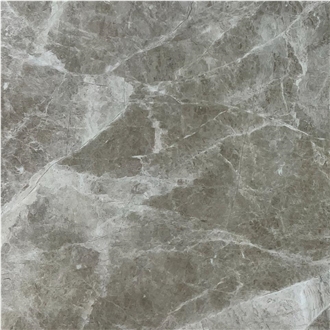
Huangpo Grey Marble features a warm, earthy yellowish-tan to ochre base, creating a natural and grounded appearance with subtle variations in golden, beige, and brownish tones. The surface is heavily mottled with irregular dark brownish-grey speckles and larger amorphous patches, giving the stone an organic appearance reminiscent of weathered rock or mossy terrain.
Texture & Structure:
Fine- to medium-grained crystalline texture with a dense, compact structure and a predominantly granular, matte, earthy character. The stone has relatively uniform crystalline grains interspersed with darker mineral concentrations and irregular fossil-like formations, creating visual depth without prominent linear veining.
Pattern & Veining:
Huangpo Grey Marble is largely free of conventional linear veins. Instead, its appearance is defined by dense granular mottling, irregular dark brownish-grey speckles, scattered fossil-like inclusions, and larger amorphous patches distributed across the surface. This complex, non-linear pattern creates a natural, weathered texture with a subtle stone-like or mossy visual effect.
Technical Characteristics (Indicative):
- Water Absorption: 0.30–0.80% by weight
- Density: 2680–2710 kg/m³
- Flexural Strength: 10–11 MPa
- Compressive Strength: 90–100 MPa
- Open Porosity: 0.30–1.50% by volume
- Hardness: 3–4 Mohs
Mineral Composition (Indicative, % by weight):
- Calcite: 80–92%
- Dolomite: 3–10%
- Quartz: 1–4%
- Clay Minerals: 1–4%
- Mica/Chlorite: 0–2%
- Iron-Bearing and Accessory Minerals: 0–2%
Chemical Composition (Indicative, % by weight):
- CaCO₃: 78–91%
- MgCO₃: 2–7%
- SiO₂: 1–4%
- Al₂O₃: 0.5–2.5%
- Fe₂O₃: 0.3–2.0%
- Other Oxides: 0–2%
Usage:
Suitable for interior flooring, wall cladding, feature walls, bathroom walls, vanity tops, countertops, backsplashes, fireplace surrounds, stairs, reception areas, tabletops, furniture, decorative panels, and other architectural applications. Its earthy, granular appearance is particularly suitable for projects requiring a natural and subdued aesthetic.
Finishes:
Honed, polished, leathered, brushed, sanded, tumbled, waterjet, and other custom finishes.
Maintenance:
Clean with a pH-neutral stone cleaner and a soft cloth or mop. Avoid vinegar, lemon, acidic cleaners, bleach, and abrasive products. Seal according to the stone's porosity and intended application, particularly for countertops, bathrooms, and flooring. Wipe spills promptly to minimize staining and avoid prolonged exposure to oils or strongly pigmented substances.
Note: The technical, mineralogical, and chemical values are indicative ranges for database reference and should be verified by quarry-specific laboratory testing for individual lots or batches.


 China

 Italy

 Turkey

 Spain

 India


 Greece


 Iran