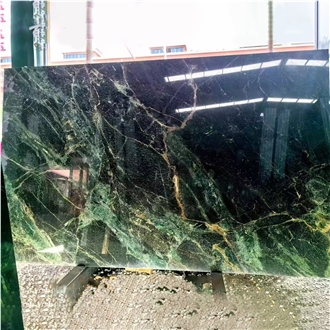
Patek Green Marble features a distinctive combination of translucent pale green to olive tones in the upper section and deep forest green to charcoal shades in the lower section. The gradual transition between these colors creates a misty, horizon-like appearance with a dramatic natural landscape effect.
Texture & Structure:
The stone exhibits a crystalline marble structure with areas of cloudy mineral distribution and intricate vein networks. Its visual texture varies from relatively soft, translucent-looking green zones to darker, denser-looking areas. Polishing can enhance the depth of the green tones, the contrast between light and dark regions, and the visibility of the natural veining.
Pattern & Veining:
Patek Green Marble is characterized by a dramatic, landscape-like pattern. The lower dark green and charcoal areas contain intricate, web-like pale veins resembling leaf veins, branching roots, or fine natural networks. These patterns gradually fade into a softer, cloudy transition zone, occasionally accented by subtle brownish tones. The combination of flowing color bands, delicate veining, and organic transitions gives each slab a distinctive appearance.
Technical Characteristics:
- Water Absorption: 0.25–0.40% by weight
- Bulk Density: 2680–2720 kg/m³
- Flexural Strength: 10–12 MPa
- Compressive Strength: 90–100 MPa
- Open Porosity: 0.3–2.0% by volume
- Hardness: Approximately 3–4 Mohs
Mineral Composition (% by weight):
- Calcite: 75–93%
- Dolomite: 2–10%
- Quartz: 1–5%
- Mica and Chlorite: 0.5–4%
- Iron-Bearing Minerals: 0.2–3%
- Other Accessory Minerals: Trace–3%
Chemical Composition (% by weight):
- Calcium Carbonate (CaCO₃): 75–93%
- Magnesium Carbonate (MgCO₃): 1–7%
- Silicon Dioxide (SiO₂): 1–6%
- Aluminum Oxide (Al₂O₃): 0.2–3%
- Iron Oxide (Fe₂O₃): 0.2–3%
- Other Oxides: Trace–3%
Usage:
Suitable for interior flooring, wall cladding, feature walls, bathroom walls, vanity tops, backsplashes, fireplace surrounds, reception areas, tabletops, furniture, decorative panels, and bespoke architectural installations. Its landscape-like pattern makes it particularly suitable for statement walls, bookmatched installations, and luxury interior designs. Backlit applications should only be considered after confirming actual light transmission through the selected slab.
Finishes:
Polished, honed, brushed, leathered, and other custom finishes, subject to supplier availability and the stone's physical characteristics.
Maintenance:
Clean with a pH-neutral stone cleaner and a soft cloth or mop. Avoid vinegar, lemon juice, acidic cleaners, bleach, and abrasive products, which may damage the marble surface. Sealing is recommended according to the stone's porosity and intended application, particularly for countertops, vanity tops, and bathroom surfaces. Wipe spills promptly to minimize staining and etching. Use protective pads beneath objects and avoid dragging heavy items across the surface.
Technical Note: The physical properties, hardness, mineral composition, and chemical composition listed above are indicative estimates, not verified laboratory results for a specific quarry lot. Actual values may vary by quarry block and production batch. The pale green areas should not be assumed to be translucent throughout the slab; confirm light transmission and structural integrity with the supplier. Accredited laboratory testing is recommended for projects with specific technical requirements.


 China

 6YR




 Italy

 Turkey



 Spain

 India

 Iran


 Myanmar


