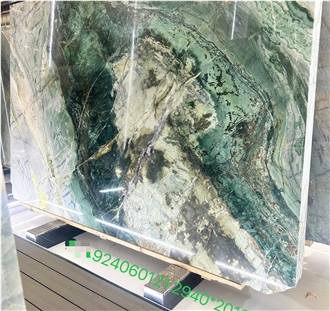
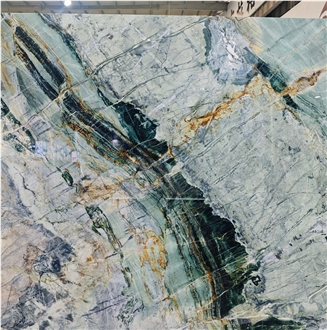
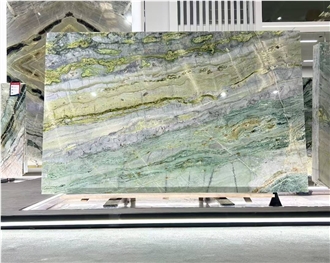
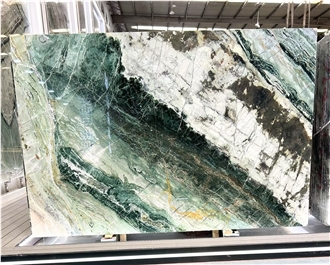
Prague Green Marble is a decorative green marble quarried in China, featuring a dynamic blend of deep emerald green, forest green, and lighter mint-green tones. Creamy-white and pale-gray areas contrast with the green background, while subtle brownish and bronze-colored mineral accents add warmth and depth. Its distinctive appearance makes it suitable for luxurious interior applications.
Texture & Structure
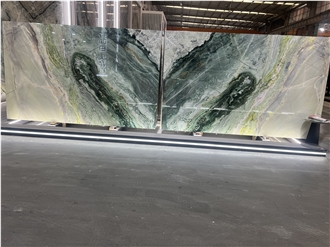
The stone features dramatic, flowing veins and swirling patterns that create a layered, wave-like appearance. Irregular dark-green pockets alternate with lighter green areas and prominent creamy-white streaks. Its texture is generally fine to medium-grained, with variations in mineral distribution and veining from slab to slab. Natural fissures, veins, and localized mineral concentrations may occur.
Chemical & Mineralogical Composition
The exact mineralogical and chemical composition of Prague Green Marble requires laboratory analysis. Green coloration in decorative marbles may result from minerals such as serpentine or chlorite, while white veins may contain calcite or dolomite. Quartz, iron-bearing minerals, and other accessory minerals may also be present, depending on the geological origin.
Usage
Prague Green Marble is suitable for interior wall cladding, feature walls, flooring, bathroom walls, vanity tops, decorative panels, fireplace surrounds, countertops, tabletops, reception desks, and luxury interior design projects. Its flowing patterns are particularly attractive for bookmatched slabs and statement installations. Suitability for wet areas and countertops depends on porosity, chemical resistance, and the results of technical testing.
Maintenance
Clean the surface with a pH-neutral stone cleaner and a soft cloth. Avoid acidic cleaners, abrasive products, and harsh chemicals that may damage the polished surface. Apply a suitable penetrating stone sealer if testing indicates that protection is necessary, particularly for countertops and bathroom installations. Wipe up oils and colored liquids promptly, and periodically inspect the surface for staining or deterioration of the sealant.


 China
 2YR




 Italy

 Turkey



 Spain

 India


 Iran


 Bolivia

 Greece