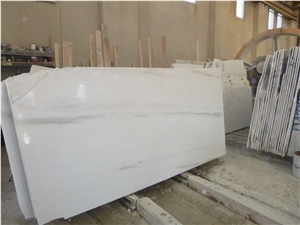
Prinos Commercial Marble

About
Item Details
- Material Type:
- Marble
- Origin:
Greece (Limenas and Theologos areas, Thassos Island) - Primary Color(s):
- White
- Recommended Usage:
- Kitchen and bathroom countertops, wash basins, building stone, ornamental stone, stairs, interior, exterior wall and floor applications, mosaic, waterjet pattern, wall panels, table tops, balustrades, columns, wall and pool copings, pool pavers, sculptures, fireplaces, window sills
- Additional Names:
- Prinos Marble, Prinos Gold Marble, Limenas White Marble, Prinos White Marble, Thassos Limenas White Marble, Prinos A1 Marble, Prinos A1-2 Marble, Prinos Commercial White Marble, Prinos Commercial, Prinos Commercial Marble
- Finished Surface:
- Polished,Bush Hammered,Tumbled,Brushed,Honed,Split,Machine Cut,Natural Surface,Sandblasted,Combed,Leathered,Water Jet,Filled,Chiseled,Pickling
Testing
- Water Absorption:
- 0.1 By weight % (EN 13755 : 2001 (AC : 2003))
- Density:
- 2840 kg/m3 (EN 1936 : 1999)
- Flexural Strength:
- 15.91 MPa (EN 12372 : 1999 (AC : 2002))
- Compressive Strength:
- 151.61 MPa (EN 1926 : 1999)
Description
Prinos Commercial Marble is a fine to medium crystalline dolomitic marble known for its predominantly bright white color that epitomizes the classic marble appearance. It is characterized by its clean and elegant look, often showcasing subtle crystalline or faint grey accents depending on the specific block or quarry face. This marble is sourced from the Limenas and Theologos areas on Thassos Island, Greece. It is renowned for its timeless beauty and suitability for a variety of architectural and design applications, both indoors and outdoors.
Physical and Mechanical Properties
- Water Absorption: 0.1% by weight (EN 13755:2001 (AC:2003))
- Density: 2840 kg/m³ (EN 1936:1999)
- Flexural Strength: 15.91 MPa (EN 12372:1999 (AC:2002))
- Compressive Strength: 151.61 MPa (EN 1926:1999)
- Hardness: Generally considered medium on the Mohs scale, conducive for both ornamental and practical applications.
- Porosity: Low, enhancing its resistance to weathering and staining.
- Slip Resistance: Can vary depending on surface finish, but generally enhanced through treatments for specific applications.
Petrographic Examination
- Dolomite: 94 %
- Calcite: 5 %
- Albite: 1 %
Usage
- Interior Applications: Ideal for flooring, cladding, stairs, countertops, and decorative elements.
- Exterior Applications: Suitable for facades, landscaping, and other elements where weather resistance is essential.
- Special Applications: Can be used in high-humidity areas due to low porosity and water absorption rates.
Maintenance
- Regular cleaning with neutral pH cleaners to maintain surface integrity.
- Sealing may be recommended to enhance stain resistance, especially in high-traffic or spill-prone areas.
- Avoid acidic cleaners to prevent etching.
Common Surface Finish Options
- Polished: High gloss finish that brings out the marble's deep luster and color.
- Honed: Smooth, matte finish that provides a more subtle appearance and improved slip resistance.
- Brushed/Antiqued: Offers a textured surface that highlights the marble's natural character.
- Sandblasted: Textured finish that enhances slip resistance for outdoor or wet area applications.
Prinos Marble, with its pristine white aesthetic and versatile properties, is a sought-after choice for architects and designers aiming to incorporate classic elegance into their projects. Its adaptability in both aesthetics and applications makes it an esteemed material for various uses, while its Greek origin adds a touch of historical richness and regional authenticity.
Test Result:
Physical and Mechanical Properties
- Apparent Density: 2,840 kg/m³ — EN 1936:1999
- Open Porosity: 0.4 % vol. — EN 1936:1999
- Water Absorption at Atmospheric Pressure: 0.1 % wt. — EN 13755:2001 (AC:2003)
- Compressive Strength: 151.61 MPa — EN 1926:1999
- Flexural Strength under Concentrated Load: 15.91 MPa — EN 12372:1999 (AC:2002)
- Frost Resistance (Compressive Strength): 145.10 MPa — EN 12371:2001 (EN 1926:1999)
- Rupture Energy: 3 J — EN 14158:2004
- Abrasion Resistance: 21,287 mm³ — EN 14157:2004 (Method B)
- Thermal Conductivity (λ): 4.722 W/m·K — N/A
- Specific Heat Capacity (Cp): 3,344 kJ/m³·K — N/A


10YR