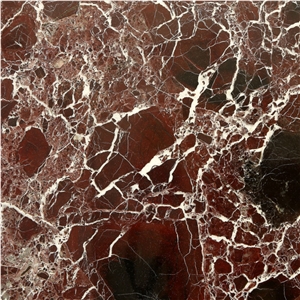
Rosa Corallo Marble is a classic and esteemed red marble originating from the Verona region in Veneto, Italy. This distinctive natural stone features a warm reddish to terracotta background interspersed with lighter calcite fossils, subtle white veins, and natural tonal variations. Its enduring beauty and historical significance make it a sought-after choice for both traditional and modern architectural applications.
Physical and Mechanical Properties:
- Water Absorption: 0.19%
- Density: 2690 kg/m³
- Flexural Strength: 9.8 MPa
- Compressive Strength: 150.0 - 160.0 MPa
- Hardness: Generally rated on the Mohs scale for marble, between 3 and 4.
- Porosity: Low, contributing to the stone's density and durability.
- Slip Resistance: This can vary based on the finish of the marble but generally requires treatment to avoid slipperiness when wet.
Chemical and Mineral Compositions (Approximate % by weight):
- Calcite (CaCO₃): Major component, usually around 90-95%.
- Dolomite (CaMg(CO₃)₂): Can be present in minor amounts.
- Quartz, Mica, and Iron Oxides: Trace elements contribute to colors and patterns.
- Silica (SiO₂): Small percentages, rarely above 2%.
Applications and Usage:
- Interior Flooring and Wall Cladding: Preferred for its aesthetic appeal in residential and commercial projects.
- Countertops: Offers a striking appearance for kitchens and bathrooms.
- Fireplace Surrounds: Adds warmth and elegance to living spaces.
- Monumental and Sculptural Uses: Valued for its workability and historical appeal.
Maintenance:
- Sealing: Requires regular sealing to protect against stains and moisture.
- Cleaning: Use pH-neutral cleaners to maintain the stone’s natural shine, avoid harsh chemicals that can etch or dull the surface.
Cutting Sizes (Commonly Available):
- Tiles: Can range from small (e.g., 30x30 cm) to larger formats (e.g., 60x60 cm or 120x60 cm) depending on project requirements.
- Slabs: Typically cut into thicknesses of 2 cm and 3 cm for various applications.
Surface Finish Options:
- Polished: Offers a high-gloss finish, enhancing the marble's natural colors and veining.
- Honed: Provides a matte, non-glossy surface, ideal for areas where slip resistance is important.
- Brushed/Antiqued: A textured finish that gives a rustic look while enhancing slip resistance.
- Sandblasted: A rougher texture suitable for outdoor or industrial applications.
Rosa Corallo Marble's enduring charm makes it an ideal material for a wide array of architectural and decorative applications. Its warm hues and classic appeal ensure it remains a favorite in design projects worldwide.
- Petrographic definition: Limestone
- Mass per unit volume: 2,690 kg/m³
- Water absorption: 0.19%
- Compressive strength (simple): 160 MPa
- Compressive strength after freezing: 150 MPa
- Indirect tensile strength (by bending): 9.8 MPa
- Abrasion coefficient (referred to Granite, St. Fedelino): 0.61
- Impact resistance (minimum fall height): 38 cm
- Coefficient of linear thermal expansion: 9.4 × 10⁻⁵ °C⁻¹
- Knoop microhardness: 1,570 MPa
- Hardness non-uniformity index: 1.28
Source: Università di Pisa - Politecnico di Torino


 Italy

 Turkey

 3YR

 China


 Germany


 Chile


 Iran

 Spain

 France


 Myanmar


