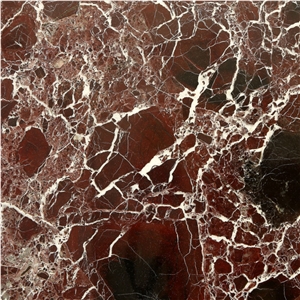
Rosso Cait Marble is an exquisite natural stone known for its distinctive deep red background, accented by striking white and reddish-white grains, often referred to as bioclasts. Its visual appeal is enhanced by variations in color intensity, which can sometimes exhibit an orangey-red hue. Geologically, this stone is classified as a limestone, but in the stone industry, it is marketed and used as marble, making it a popular choice for various decorative purposes. Quarried primarily in the Cervenilla Quarry in Rahovec, Đakovica, Southeastern Kosovo, it is renowned for its unique aesthetic and physical properties.
Physical and Mechanical Properties:
- Water Absorption: Typically low, ensuring durability in various environments.
- Density: Approximately 2,680 - 2,720 kg/m³, characteristic of a dense and robust stone.
- Flexural Strength: Ranges usually between 8 - 13 MPa, indicating moderate resistance to bending.
- Compressive Strength: Generally between 80 - 120 MPa, showcasing its ability to withstand heavy loads.
- Hardness: Rated around 3-4 on the Mohs scale, suitable for interior use with care.
- Porosity: Low, aiding in its resistance to stains and damage.
- Slip Resistance: Finishes can affect this; typically polished surfaces are more slippery, whereas honed or textured surfaces provide better traction.
Chemical and Mineral Composition (approximate % by weight):
- Calcium Carbonate (CaCO3): Main component, ranging from 85% - 95%.
- Iron Oxides (Fe2O3): Contribute to the red coloration, around 1% - 3%.
- Silica (SiO2): Minor amounts, generally 1% - 3%.
- Alumina (Al2O3): Typically less than 1%.
- Magnesium Carbonate (MgCO3): Approximately 1% - 2%.
Usage:
- Interior Design: Ideal for flooring, wall cladding, countertops, and decorative elements.
- Exterior Applications: Suitable for facades, though maintenance considerations due to outdoor exposure are necessary.
- Artistic Projects: Used for sculptures and artistic installations due to its unique color profile.
Maintenance:
- Regular cleaning with mild pH-neutral cleaners.
- Sealants can be applied to enhance resistance to stains and maintain surface luster.
- Avoid abrasive cleaners to prevent surface scratches.
Cutting Sizes (cm):
- Standard slabs and tiles typically available in thicknesses of 2 cm and 3 cm.
- Customizable sizes to meet specific project requirements.
Common Surface Finish Options:
- Polished: Offers a high-gloss finish that highlights the stone’s vibrant color but requires regular maintenance to avoid scratches.
- Honed: Provides a matte, smooth finish, reducing visual glare and enhancing slip resistance.
- Brushed/Antiqued: Gives a textured appearance, adding character and improving slip resistance.
- Sandblasted: Creates a lightly rough surface texture, ideal for exterior applications.
In conclusion, Rosso Cait Marble is a versatile and appealing choice for both aesthetic and structural applications, valued for its distinctive appearance and reliable performance characteristics. Whether used in residential or commercial settings, it contributes elegance and uniqueness to any architectural design.


 Kosovo

 United Kingdom


 Italy


 Iran

 Spain

 France


 Myanmar


 China


