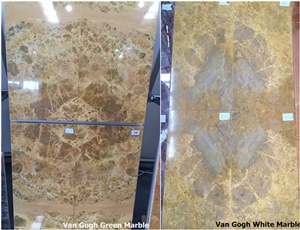
Van Gogh Green Marble

About
Item Details
- Material Type:
- Marble
- Origin:
China - Recommended Usage:
- Kitchen and bathroom countertops, wash basins, building stone, ornamental stone, stairs, interior, exterior wall and floor applications, mosaic, waterjet pattern, wall panels, table tops, balustrades, columns, wall and pool copings, pool pavers, fireplaces
- Additional Names:
- Jade Green Marble, Van Gogh Marble, in China stone market:梵高(Fàn Gāo)
- Finished Surface:
- Polished,Bush Hammered,Tumbled,Brushed,Honed,Split,Machine Cut,Natural Surface,Sandblasted,Combed,Leathered,Water Jet,Filled,Chiseled,Pickling
Testing
- Water Absorption:
- 0.08–0.12% by weight
- Density:
- 2710 kg/m³
- Flexural Strength:
- 10–14 MPa
- Compressive Strength:
- 80–95 MPa
Description
Van Gogh Green Marble is a premium natural stone celebrated for its luminous quality and artistic veining. The marble features a deep charcoal-gray base contrasted with vibrant, almost translucent green-yellow hues, producing striking color contrasts that reflect light beautifully. Its intricate, flowing veins resemble brushstrokes, evoking the expressive style of the famous painter Van Gogh. Each slab is unique, offering dynamic visual depth and elegance.
Texture & Pattern
- Fine-grained with occasional natural crystalline accents
- Flowing, organic veining resembling brushstrokes
- Each slab exhibits unique patterns, suitable for statement installations
Surface Finishes
- Polished – high-gloss, reflective finish enhancing color and veining
- Honed – smooth, matte finish for contemporary interiors
- Leathered – soft, tactile textured surface
- Tumbled – slightly aged, rustic appearance
- Brushed – soft, subtle texture
- Sawn Cut / Split – natural raw surfaces for cladding or landscaping
- Waterjet – decorative cuts for artistic or patterned applications
Technical Properties
- Density: ~2,710 kg/m³
- Bulk Density: 2,710–2,730 kg/m³
- Open Porosity: 0.35–0.50%
- Water Absorption: 0.08–0.12% by weight
- Compressive Strength: 80–95 MPa
- Flexural Strength: 10–14 MPa
- Mohs Hardness: 3–4
- Abrasion Resistance: 0.2–0.5 g/cm²
Chemical & Mineral Composition (% by weight)
- Calcium Carbonate (CaCO₃): 92–96%
- Magnesium Oxide (MgO): 0.5–1.5%
- Silica (SiO₂): 1–2%
- Iron Oxide (Fe₂O₃): 0.3–0.6%
- Trace minerals (mica, feldspar, serpentine): 0.1–1%
Applications
- Interior feature walls and accent panels
- Flooring in luxury spaces
- Countertops, vanity tops, tabletops, and furniture cladding
- Stairs, risers, columns, and decorative installations
- Fireplaces, sculptural elements, and artistic projects
Maintenance
- Clean with neutral pH cleaners; avoid acidic or abrasive agents
- Periodic sealing recommended in high-traffic areas
- Polished surfaces require soft cloth cleaning to maintain shine
FAQ
Van Gogh Green Marble is a natural stone and, like many marbles, it has some heat resistance. However, it is not as heat resistant as materials like granite or quartzite. Marble can be sensitive to heat, and placing hot pots or pans directly on the surface can potentially cause damage or discoloration. Its advisable to use trivets or heat pads to protect the marble surface from direct heat to maintain its appearance and longevity.
How to repair the cracked Van Gogh Green Marble kitchen countertop edge?
Repairing a cracked Van Gogh Green Marble kitchen countertop edge requires careful attention to detail and the right materials. Here’s a step-by-step guide to help you with the repair:
1. **Assess the Damage:**
- Examine the crack to determine its length, depth, and whether there are any loose pieces that need to be addressed separately.
2. **Gather Materials:**
- Epoxy resin or a marble repair kit designed for stone surfaces.
- Matching marble dust or tint (if needed) to blend the repair with the existing marble.
- Clamps or masking tape to hold pieces in place if the crack is wide.
- Gloves, safety goggles, masks (to protect from dust and fumes).
3. **Clean the Area:**
- Use a soft cloth and a mild detergent to clean the cracked area thoroughly.
- Ensure the area is dry before proceeding with the repair.
4. **Prepare the Epoxy:**
- Mix the epoxy resin according to the manufacturers instructions.
- If necessary, add marble dust or tint to the epoxy to closely match the color of your marble.
5. **Apply the Epoxy:**
- Carefully apply the mixed epoxy into the crack using a spatula, putty knife, or a similar tool.
- Ensure the epoxy fills the crack completely and is level with the surface.
6. **Set and Secure:**
- If there are any loose pieces, gently press them into place over the epoxy application.
- Use clamps or secure with masking tape to hold everything in place while the epoxy cures.
7. **Curing:**
- Allow the epoxy to fully cure as per the manufacturers recommendations. This can take several hours to a day.
8. **Finish:**
- Once the epoxy is fully cured, use fine-grit sandpaper to smooth out any excess epoxy on the surface.
- Carefully polish the repaired area with a marble polishing compound to restore its shine.
9. **Seal the Marble:**
- Apply a marble sealer over the entire repaired edge to protect it from future staining or damage.
### Tips:
- Ensure the room is well-ventilated during the repair process.
- For best results, consider practicing on a scrap piece of marble first if you’ve never done this before.
- If the crack is extensive or located in a structurally critical area, consider consulting a professional.
If you are unsure or uncomfortable performing the repair yourself, hiring a professional stone repair technician might be the best option.
Can Van Gogh Green Marble surface be flamed finish?
Van Gogh Green Marble, like other natural stone materials, can be subjected to various surface finishes, including a flamed finish. However, it is important to note that marble, being a metamorphic rock composed primarily of calcite, is significantly softer and more susceptible to weathering compared to granite or other igneous rocks that are typically flamed.
The flaming process involves exposing the stone surface to high-temperature heat to create a textured, slightly rough surface finish. For marble, this process may not produce the same even, consistent results as it does with harder stones like granite, and theres a possibility of causing damage or unevenness. Additionally, the heat can affect the color and integrity of the marble.
If you are considering a flamed finish for Van Gogh Green Marble, its essential to consult with a professional stone fabricator or supplier to understand the possible outcomes and ensure the process is suitable for your specific application. They may recommend alternative finishes, such as honed or brushed, that could better preserve the stones aesthetics and structural integrity.
Is 2 cm too thin for a Van Gogh Green Marble kitchen countertop?
A 2 cm thickness for a marble countertop, including Van Gogh Green Marble, can be considered on the thinner side but is commonly used in some kitchen designs. Whether its suitable for your kitchen depends on several factors:
1. **Support and Stability**: Thinner countertops need adequate support to prevent cracking and ensure stability. You may need additional support underneath, particularly around edges and cutouts for sinks or appliances.
2. **Aesthetic Preference**: Some people prefer the sleeker, modern look of a thinner countertop, while others might want the more substantial appearance of a thicker slab, typically 3 cm or more.
3. **Cost**: Thinner slabs may reduce material costs but could require additional expenses in reinforcing the structure.
4. **Strength and Durability**: Although marble is relatively strong, its a softer stone compared to granite or quartz, which means a thinner slab is more susceptible to damage. Ensure that it is properly maintained and sealed.
5. **Installer Recommendations**: Consult with a professional installer or kitchen designer. They can assess your specific situation and advise whether additional support will be necessary and if any design adaptations are needed.
In conclusion, a 2 cm thick Van Gogh Green Marble countertop can work beautifully in a kitchen with the proper support and installation, but its essential to weigh these factors before making your decision.
How to make Van Gogh Green Marble stairs less slippery?
To make Van Gogh Green Marble stairs less slippery, you can employ several strategies to improve traction and safety:
1. **Anti-Slip Treads or Strips:**
- Apply adhesive anti-slip treads or strips specifically designed for stone surfaces. These can be clear or colored to match the aesthetics of the marble.
2. **Non-Slip Mats or Rugs:**
- Use non-slip mats or carpet runners designed for stairs. Ensure they are securely fastened to avoid any movement.
3. **Surface Treatments:**
- Consider applying a stone-specific anti-slip coating. These coatings increase traction while being transparent to preserve the marbles natural beauty.
4. **Etching the Surface:**
- Have a professional etch the surface of the marble to create a textured, non-slip finish. This method permanently modifies the stones surface.
5. **Sealant with Anti-Slip Properties:**
- Use a sealant that includes anti-slip additives. Check that it is suitable for marble.
6. **Regular Cleaning:**
- Keep the stairs clean and free from dust, debris, and spills, as these can increase slipperiness.
7. **Footwear Suggestions:**
- Encourage wearing shoes with good grip when using the stairs.
8. **Handrails Installation:**
- Ensure that sturdy handrails are installed on both sides of the staircase to provide support.
Always test any product or method on a small, inconspicuous area of the marble first to ensure it doesn’t damage or discolor the stone. Consider consulting with a professional for a solution tailored to your specific needs and the characteristics of your marble.
Are polished Van Gogh Green Marble steps slippery?
Polished Van Gogh Green Marble steps can indeed be slippery, especially when wet. The polishing process gives the marble a smooth and shiny surface, which can reduce traction compared to unpolished or honed finishes. If safety is a concern, especially in areas prone to moisture, it might be a good idea to consider adding anti-slip treatments or mats to reduce the risk of slipping. Alternatively, selecting a different finish or material with better grip may also be advisable.


14YR