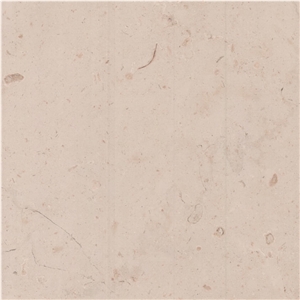
Archaean Century Limestone — a warm, sandy-beige Jordanian limestone with golden highlights and prominent fossil segment patterns, quarried from the Ajloun / Deir ʿAllā region (≈40–50 km NW of Amman).
Visual & tactile characteristics
- Background colour: warm sandy beige with golden-yellow hues and occasional cream tones.
- Pattern: abundant fossil segments (shell fragments, bioclasts) and bedding lines that create organic, rhythmic texture — from subtle veining to clearly visible rounded fossil sections.
- Texture: typically fine- to medium-grained calcitic matrix hosting coarser fossil fragments; feels slightly grainy to the touch where fossils are exposed, smoother on compact calcitic areas.
- Appearance variability: natural variation in tone and fossil density between blocks; veining and fossil clustering can produce feature/bespoke slabs ideal for focal walls or reception counters.
Typical mineral & chemical composition
(typical ranges — laboratory testing required for contract)
- Calcium carbonate (CaCO₃, mainly calcite): 94.0 – 98.0 %
- Magnesium (as MgO / dolomite): 0.1 – 1.0 %
- Silica (SiO₂ — quartz, siliceous grains): 0.3 – 3.0 %
- Alumina (Al₂O₃ — clays): 0.1 – 1.0 %
- Iron oxides (Fe₂O₃): 0.01 – 0.5 %
- Organic carbon / humic mattertrace – 1.0 %
- Others (sulfides, phosphates, trace minerals): trace amounts
Mineralogy:predominantly calcite (CaCO₃) with local occurrences of dolomite, minor quartz grains, and clay minerals (illite/kaolinite) in minor amounts. Fossil fragments are shell-carbonate and skeletal debris (bioclasts).
Note: those are representative ranges for a fossiliferous Jordanian limestone of this style. For engineering or chemical specifications, request a certified lab analysis of the exact block/lot.
Mechanical & physical test data
- Water absorption: 0.7 – 1.2 % ( typical for moderately dense limestone)
- Bulk density / apparent density: ≈ 2655 kg/m³
- Flexural strength (Modulus of Rupture): 8 – 11 MPa
- Compressive strength (typical range): ~40 – 110 MPa (depends on porosity, fossil content and bedding) — measure before structural use.
- Mohs hardness: ~3.0 – 3.5 (soft-to-moderate; scratches with harder minerals/abrasives)
- Porosity (open porosity): typically 1–6 % (correlates with water absorption; fossil porosity may be higher locally)
- Freeze–thaw resistance: moderate — good in sheltered exterior uses if properly installed and drained; in climates with frequent freeze–thaw cycles some protective detailing and sealers are recommended.
- Thermal behaviour: low thermal expansion; stable for interior and shaded exterior facades.
Recommended technical uses
- Interior: flooring (low–medium traffic), wall cladding, feature walls, fireplaces, reception desks, vanity tops (with sealer), stair treads (with appropriate finish), indoor columns and sculptural elements.
- Exterior (with caution): light exterior cladding, window surrounds, landscape steps and low-wear facades — best in climates without extreme acid rain or very aggressive freeze cycles and when protected from direct splash/soil contact.
- Architectural: hotel lobbies, upscale retail, museum interiors and other high-design applications where fossil texture is a desired focal point.
Not recommended for: heavy industrial floors, areas exposed to strong acids/alkalis, or very high abrasion without protective surface treatment.
Surface finish options
- Polished: glossy, deep colour but shows scratches and requires more maintenance; fossils become accentuated.
- Honed: smooth, low sheen — good for flooring and countertops where lower reflectivity is desired.
- Leathered / brushed: textured, hides scratches and slip better — excellent for countertops and feature walls.
- Sandblasted / bush-hammered: matte/textured, suitable for non-slip exterior use and dramatic tactile surfaces.
- Tumbled: aged, softened edges — good for rustic floors and mosaics.
- Sawn / honed edge (raw): for a contemporary, minimal look.
Choose finish based on slip resistance, appearance, and maintenance expectations.
Typical cutting sizes & tolerances
- Blocks: typical quarried block sizes vary; common export block sizes ~ 1.2–3.0 m (length) × 1.0–1.8 m (width) × 0.6–1.2 m (height) depending on quarry.
- Slabs (standard): 300 × 160 cm, 320 × 180 cm, 240 × 120 cm (availability depends on block size and sawing technique).
- Slab thicknesses (finished): 2 cm (20 mm) and 3 cm (30 mm) are standard for countertops and cladding. Super-thin 10–12 mm and large format panels can be produced per request but depend on structural integrity.
- Tiles / cut-to-size: typical tile sizes available: 60×60 cm, 60×120 cm, 30×60 cm, custom cut sizes possible.
- Tolerance: sawn slab thickness ±2 mm typical; finished cut tolerances depend on fabricator but ±1–2 mm is common for precision work.
Maintenance & care
- Sealing: highly recommended (penetrating / impregnating sealer) for countertops, flooring and exterior exposed faces to reduce staining and slow water ingress. Reapply sealers per manufacturer guidance (typically annually or per traffic).
- Daily cleaning: pH-neutral stone cleaner or mild dish soap and water. Avoid acidic cleaners (vinegar, lemon), bleach or ammonia which can etch calcitic stone.
- Stain management: blot spills quickly (especially oil, wine, coffee). Use poultices for oil or deep stains.
- Repairs: small chips and fissures may be filled with color-matched epoxy or resin; large repairs should be handled by a stone restoration specialist.
- Exterior care: keep drainage details clean; avoid soil contact and de-icing salts on finished surfaces (can cause surface degradation over time).
Installation & specification notes
- Orientation: pay attention to vein/fossil orientation for visual continuity across slabs. Bookmatching or vein-matching can produce dramatic effects.
- Anchoring & support: for heavy façade panels or large slabs provide adequate mechanical anchoring and backup support; check load calculations with the engineer.
- Cutting & prefabrication: use diamond tools and water cooling; fossils and fossil pockets may require special attention to avoid chipping or breakouts.
- Edge profiles: standard eased, bullnose, mitred island tops, and custom profiling are achievable; very thin edges over large spans should be supported to avoid breakage.
Health & environmental
- Silica content: low-to-moderate — standard cutting dust controls (wet cutting, local extraction, PPE) recommended.
- Sustainability: quarrying impacts are site dependent — request quarry reclamation and environmental practice documents if needed for certification (LEED, BREEAM, etc.).
Lab testing & certificates (recommended)
Before final approval for a project, obtain certified laboratory reports for the exact lot/block/slab covering:
- Petrographic analysis (thin section)
- Bulk density & open porosity
- Water absorption & capillarity
- Flexural & compressive strength (EN / ASTM standard tests)
- Freeze–thaw resistance (if exposed)
- Chemical analysis (XRF) for exact composition
- Slip resistance (for flooring finishes)


 Jordan

 15YR

 China


 Saudi Arabia

 Turkey

 Germany

 Italy

 Spain

 Portugal

 Norway

 Croatia

 Bulgaria


 France
