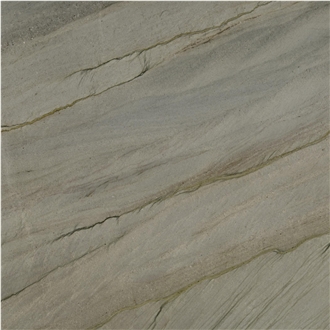
Elegant Green Quartzite features a deep, dark olive-green to brownish-green base, with intricate, intersecting diagonal veins in lighter green and grey sweeping across the surface to create a dynamic, web-like structure. The stone is dramatically speckled with numerous white to light-grey spots resembling drifting snow or stars, complemented by occasional glowing yellowish-green and orange reflections under light, creating an exotic and luxurious appearance; quarried in the Pantanal region of Brazil.
Color & Appearance:
Elegant Green Quartzite features a deep, dark olive-green to brownish-green base with a rich, exotic appearance. Numerous white to light-grey spots are scattered across the surface, resembling drifting snow or distant stars, while occasional yellowish-green and orange mineral reflections become more pronounced under light.
Texture & Structure:
The stone has a fine- to medium-grained crystalline texture with a dense, compact structure. Interlocking quartz crystals create a hard, durable surface with subtle crystalline depth and natural mineral variation. The surface can display a slight directional structure associated with the arrangement of quartz and accessory minerals.
Pattern & Veining:
Intricate intersecting diagonal veins in lighter green and grey sweep across the surface, forming a dynamic web-like structure. The contrasting white and light-grey spots are distributed throughout the stone, while localized yellowish-green and orange mineral accents create additional depth and movement.
Technical Characteristics (Indicative):
- Water Absorption: 0.08–0.20% by weight
- Density: 2680–2730 kg/m³
- Flexural Strength: 18–20 MPa
- Compressive Strength: 200 - 220 MPa
- Apparent Porosity: 0.20–0.70%
- Hardness: 6–7 Mohs
Mineral Composition (Indicative, % by weight):
- Quartz: 85–92%
- Feldspar: 2–6%
- Chlorite/Epidote: 2–6%
- Mica/Fuchsite: 1–4%
- Rutile: 0–2%
- Iron-bearing Minerals: 0–2%
- Accessory Minerals: 0–2%
Chemical Composition (Indicative, % by weight):
- SiO₂: 85–94%
- Al₂O₃: 2–6%
- Fe₂O₃: 1–4%
- MgO: 1–4%
- CaO: 0–2%
- K₂O: 0.5–2%
- Na₂O: 0–2%
- Cr₂O₃: 0–1%
- Other Oxides: 0–2%
Usage:
Suitable for kitchen and bathroom countertops, vanity tops, backsplashes, feature walls, wall cladding, interior and exterior flooring, stairs, fireplace surrounds, tables, furniture, reception areas, columns, monuments, pool and wall coping, and other high-end architectural and decorative applications.
Finishes:
Polished, honed, leathered, brushed, flamed, sandblasted, and other custom finishes.
Maintenance:
Clean with a pH-neutral stone cleaner and a soft cloth or mop. Avoid strong acids, abrasive cleaners, and harsh chemicals. Although quartzite has low water absorption, sealing is recommended according to the specific slab and application, particularly for kitchen countertops and other areas exposed to staining. Wipe spills promptly and avoid prolonged contact with acidic or strongly pigmented substances.


 Brazil

 3YR

 China





 India


