G376 Granite

About
Item Details
- Material Type:
- Granite
- Origin:
China (Shandong province) - Recommended Usage:
- kitchen and bathroom countertops, monuments, building stone, ornamental stone, stairs, interior, exterior wall and floor applications, mosaic, waterjet pattern, wall panels, table tops, window sills, balustrades, columns, wall and pool copings, pool pavers, sculptures, fireplaces, pavers, cobbles, curbstone
- Additional Names:
- New Lu Grey Granite, New Shandong Grey Granite, Sand Grey Granite, in China stone market:新鲁灰(Xīn Lǔ Huī), 鲁灰(Lǔ Huī), G376 Granite
- Finished Surface:
- Polished,Flamed,Bush Hammered,Tumbled,Brushed,Honed,Split,Machine Cut,Natural Surface,Sandblasted,Acid Washing,Combed,Leathered,Water Jet,Chiseled,Pickling
Testing
- Water Absorption:
- 0.1 – 0.3 % by weight
- Density:
- 2785.6 kg/m³
- Flexural Strength:
- 11.24 MPa
- Compressive Strength:
- 171.8 MPa
Description
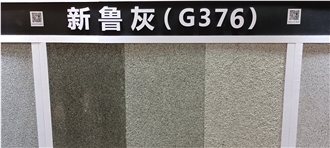
G376 Granite is a fine to medium grain natural stone quarried in Shandong Province, China. It presents a dark gray background enriched with misty mauve grains and soft pinkish hues, producing an elegant, speckled effect. Its consistent texture, durability, and warm-toned highlights make it suitable for both interior and exterior architectural applications.
Texture & Pattern
- Grain Size: Fine to medium crystalline structure
- Texture: Compact and uniform
- Pattern: Evenly speckled; pink feldspar crystals provide mauve-to-pink accents against a dark gray matrix
- Appearance: Neutral yet warm, offering a sophisticated aesthetic for modern and classic design
Physical & Mechanical Properties (tested values)
- Density : 2785.61 kg/m³ - ASTM C97
- Water Absorption : 0.05% - ASTM C97
- Compressive Strength : 171.8 MPa - ASTM C170
- Flexural Strength : 11.24 MPa - ASTM C99
- Mohs Hardness : 6–7 —
Mineral Composition (% by weight, typical)
- Quartz: 20–35%
- Feldspar (alkali & plagioclase): 50–65%
- Mica (biotite/muscovite): 2–10%
- Accessory minerals: Magnetite, ilmenite, zircon, trace garnet (<1%)
Chemical Composition (typical oxides, % by weight)
- SiO₂ (Silica): 65–75%
- Al₂O₃ (Alumina): 12–16%
- K₂O + Na₂O (Alkali oxides): 3–6%
- Fe₂O₃ / FeO (Iron oxides): 0.5–3%
- CaO, MgO, TiO₂, MnO, P₂O₅: each generally <1%
Cutting Sizes (standard commercial, cm)
- Slabs: 240–320 × 120–200 (thickness 2 cm and 3 cm)
- Tiles: 30 × 30, 40 × 40, 60 × 60, 60 × 120, 80 × 80 (thickness 1.5–2 cm)
- Steps / Risers / Borders: custom sizes
- Countertops / Vanity Tops: 120–320 cm lengths, cut-to-order
Surface Finish Options
- Polished: high gloss, highlights pink and mauve grains
- Honed: smooth, matte surface
- Flamed: rough, slip-resistant, for exterior paving
- Bush-hammered
- Brushed / Leathered
- Sandblasted
- Sawn cut
Usage
- Interior: flooring, wall cladding, staircases, countertops, vanity tops, fireplaces
- Exterior: façades, paving, kerbstones, landscaping, outdoor steps, monuments
- Commercial & Residential: excellent for heavy-duty flooring, public projects, and decorative applications
Maintenance
- Sealing: Recommended with a penetrating sealer to prevent staining; reapply every 1–3 years
- Cleaning: Neutral pH cleaner or mild soap and water; avoid acidic or harsh chemicals
- Durability: Heat- and scratch-resistant; polished surfaces retain shine with routine care
- Repair: Chips and scratches can be repaired with epoxy resins and refinishing when required
FAQ
A G376 Granite bevel marker and a slant marker are both types of grave markers, but they have different designs and styles.
1. **Bevel Marker (G376 Granite Bevel Marker)**:
- **Design**: A bevel marker is a type of grave marker that has a flat top but is slightly raised above the ground so that the back is higher than the front. This creates a beveled or slanted surface.
- **Height**: Typically, the back of the marker is about 6 to 8 inches above the ground, and the front is about 2 to 4 inches above.
- **Purpose**: The slight angle allows rain and debris to slide off more easily than a completely flat marker.
- **Appearance**: It offers a more subtle appearance compared to other upright monuments, making it a popular choice for those preferring simplicity.
2. **Slant Marker**:
- **Design**: A slant marker, as its name suggests, has a slanted face. The slant is more pronounced than that of a bevel marker, with the front typically being about 12 to 16 inches high.
- **Height**: These markers are taller and have a more upright presentation compared to bevel markers, but they are still not as tall as traditional upright headstones.
- **Purpose**: The slanted face is designed to be easily readable from a distance, providing a larger display area for inscriptions or artwork.
- **Appearance**: Slant markers can stand out more than bevel markers and are often seen as a midway option between flat markers and upright headstones.
Both types of markers can be customized with inscriptions, artwork, and other personal touches. The choice between a bevel marker and a slant marker often depends on personal preference, cemetery regulations, and budget.
Is G376 Granite a suitable choice for gravestones?
G376 Granite, also known as Bahama Blue Granite, is generally considered a suitable material for gravestones. Here are a few reasons why it might be a good choice:
1. **Durability**: Granite is well-known for its durability and resistance to weathering. It can withstand harsh environmental conditions, making it ideal for outdoor use in monuments and gravestones.
2. **Appearance**: G376 Granite, or Bahama Blue, has an attractive and unique bluish hue with occasional black and white flecks. Its aesthetic appeal can be especially fitting for a memorial piece, offering a serene and dignified appearance.
3. **Polishability**: This type of granite can be polished to a high gloss finish, enhancing its visual appeal and making inscriptions more readable.
4. **Maintenance**: Granite requires minimal maintenance and is relatively easy to clean, which is beneficial for gravestones that need to remain legible and presentable over time.
5. **Cost-Effectiveness**: While granite can be more expensive than other materials, its longevity and low maintenance requirements often make it a cost-effective choice in the long run.
However, its always important to consider the specific requirements of the cemetery regarding material and design, as well as any personal or cultural preferences when choosing a gravestone.
Can 4 cm thick G376 Granite pavers be used for a driveway?
Yes, 4 cm thick G376 Granite pavers can typically be used for a driveway. Granite is a very durable and strong natural stone, making it suitable for areas with vehicle traffic, such as driveways. However, its essential to ensure that the pavers are installed correctly to handle the weight and traffic they will experience.
Proper installation includes:
1. **Base preparation**: A well-compacted sub-base is crucial. This usually consists of a layer of compacted gravel or crushed stone.
2. **Edge Restraints**: To prevent the pavers from shifting under the weight of vehicles, strong edge restraints should be used.
3. **Joint Filling**: The joints between the pavers should be filled with a suitable material, often sand or a polymeric joint compound, to provide stability and prevent shifting.
4. **Load Considerations**: Ensure the sub-grade and base materials can support the anticipated weight and frequency of vehicle traffic.
Before proceeding, its advisable to consult with a professional contractor who can assess the specifics of your project and ensure proper installation techniques are followed.
How thick is a standard G376 Granite tactile paver?
The standard thickness for a G376 Granite tactile paver typically ranges from 2 inches (approximately 50 mm) to 3 inches (approximately 75 mm). However, the exact thickness can vary depending on the manufacturers specifications and the intended use, such as for pedestrian walkways or vehicular areas. It is essential to check with the specific supplier or manufacturer for precise details.
What are G376 Granite tactile pavers used for?
G376 Granite tactile pavers are commonly used for creating accessible and safe pathways for visually impaired individuals. These pavers feature raised patterns or textures that can be detected underfoot or with a cane, providing essential information about the path or environment. They are used in various public and private spaces, such as sidewalks, train stations, public buildings, and pedestrian crossings, to alert individuals to changes in the path, intersections, or potential hazards. The tactile surface helps ensure compliance with accessibility standards and regulations, promoting inclusivity and safety.
How far apart should G376 Granite bollards be installed?
When installing G376 granite bollards, or any type of bollard, the spacing largely depends on their intended purpose. However, a common guideline for pedestrian areas and safety-related installations is to space bollards about 3 to 5 feet apart (approximately 0.9 to 1.5 meters). This spacing helps to effectively block vehicles while still allowing easy pedestrian access.
For vehicle control, the spacing might be tighter, generally around 3 feet apart (about 0.9 meters) to prevent standard-sized cars from passing between them. Always ensure that the placement complies with local regulations and standards, as they may have specific requirements for bollard spacing based on safety studies and jurisdictional guidelines.
Can G376 Granite be used for street kerbstones?
G376 Granite can potentially be used for street kerbstones, but several factors must be considered before making a decision:
1. **Durability**: Granite is generally known for its strength and durability, making it a popular choice for kerbstones. You should verify the specific durability characteristics of G376 Granite to ensure it can withstand the mechanical stresses and environmental conditions it will face as a street kerb.
2. **Weather Resistance**: The granite should be able to withstand weather variations, including freeze-thaw cycles, without degrading.
3. **Aesthetic Considerations**: If the appearance is important for the location where the kerbstones will be used, ensure that the color and finish of G376 Granite meet the desired aesthetic criteria.
4. **Cost**: Evaluate whether the cost of using G376 Granite fits within the budget constraints of the project.
5. **Local Regulations**: Ensure that the use of G376 Granite complies with local building regulations and standards for kerbstones.
6. **Availability**: Check the availability of G376 Granite in the required quantities for your project.
It would be advisable to consult with a local supplier or expert in stone materials to confirm the suitability of G376 Granite for your specific application.


15YR


