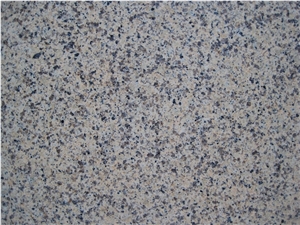
Kamai Gold Granite is a luxurious natural stone known for its fine-grain texture and stunning golden beige background. This granite features striking dark brown and black garnet patterns that create a unique and elegant appearance. Quarried in China, Kamai Gold Granite is highly regarded for its durability and sophisticated color tones, making it an excellent choice for a variety of applications, including countertops, flooring, and wall cladding. Its warm hues and eye-catching garnet inclusions add depth and character to any space, offering both timeless beauty and strength.
Mohs Hardness Scale:6-7
Mineralogical Composition, % wt:
- Quartz: 35%
- Orthoclase feldspar: 30%
- Plagioclase feldspar: 20%
- Biotite: 10%
- Muscovite: 5%
Chemical Analysis of Kamai Gold Granite % wt:
- SiO2 (Silicon Dioxide): 73.4%
- Al2O3 (Aluminum Oxide): 13.2%
- Fe2O3 (Iron Oxide): 2.3%
- CaO (Calcium Oxide): 1.9%
- MgO (Magnesium Oxide): 1.5%
- Na2O (Sodium Oxide): 3.6%
- K2O (Potassium Oxide): 3.2%
- TiO2 (Titanium Dioxide): 0.5%
- P2O5 (Phosphorus Pentoxide): 0.1%
- MnO (Manganese Oxide): 0.05%
- Cr2O3 (Chromium Oxide): 0.01%
- LOI (Loss on Ignition): 0.7%
Note: The composition of granite can vary depending on the specific location where it was quarried.


 China

 Brazil


 India


