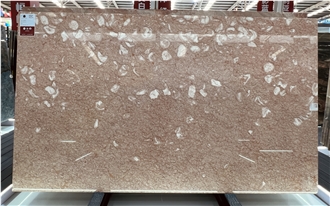
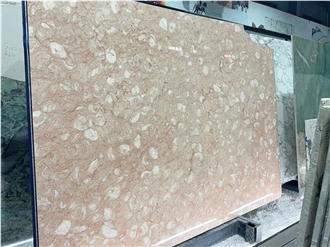
Orient Fossil Limestone is a distinctive sedimentary rock quarried in Turkey. It features an orange-golden beige background interspersed with inclusions and large white sea shell fossils, giving it a unique aesthetic. The presence of feldspar grains further adds to its appeal. This limestone may also exhibit subtle pink hues, enriching its color palette.
Physical and Mechanical Properties:
-
Water Absorption: Typically low to moderate, indicating that it might absorb some moisture but is generally considered good for construction purposes.
-
Density: Approximately 2.4 to 2.6 g/cm³, indicative of a robust, solid limestone variant.
-
Flexural Strength: Around 8 to 10 MPa, showing reasonable resistance to bending forces.
-
Compressive Strength: Ranges from 45 to 60 MPa, suggesting it is capable of withstanding substantial pressure without fracturing.
-
Hardness: Moderate on the Mohs scale (about 3-4), indicating medium softness typical of limestone.
-
Porosity: Approximately 5-20%, reflecting some level of porosity that can affect its use in areas exposed to water.
-
Slip Resistance: Typically moderate, depending on finish, which makes it suitable for certain flooring applications where slip resistance is a consideration.
Chemical and Mineral Composition (% by weight):
-
Calcite (CaCO₃): Predominantly ranges from 85% to 95%.
-
Feldspar: Approximately 2% to 5%, contributing to the mineral diversity.
-
Quartz: Around 1% to 3%, affecting hardness and wear resistance.
-
Others (incl. trace minerals and clay): 1% to 5%, influencing color and texture variations.
Usage:
- Interior Applications: Widely used for tiles, wall cladding, and fireplace surrounds due to its appealing appearance.
- Exterior Cladding: Suitable for façade work when properly sealed.
- Flooring: Ideal for areas where its aesthetic can shine, though slip resistance should be considered.
- Countertops: Can be used, but requires sealing against stains due to its porosity.
Maintenance:
- Sealing: Regular sealing advised to protect against staining and moisture infiltration.
- Cleaning: Use non-acidic, pH-balanced cleaners to avoid etching; wipe spills promptly.
- Polishing: Scheduled polishing can help maintain a glossy finish if desired.
Cutting Sizes (cm):
- Commonly available in tiles or slabs, typically in sizes such as 30x30, 30x60, 60x60, and custom dimensions as required.
Available Common Surface Finish Options:
-
Polished: Smooth and shiny, enhancing the stone's color.
-
Honed: Smooth with a matte finish, reducing reflectivity.
-
Brushed: Textured surface enhances the rustic look.
-
Tumbled: Rounded edges and aged appearance for a classic look.
Conclusion:
Orient Fossil Limestone is versatile and attractive, suitable for a variety of architectural and interior design applications. Its maintenance involves regular sealing and careful cleaning to preserve its beauty and durability. With its unique visual appeal and moderate mechanical properties, it is a valued choice in both residential and commercial design projects.


 Turkey
 3YR

 China



 Palestine

 Spain

 Italy

 Portugal

 United States

 Norway

 Croatia

 Bulgaria


 France
