Pierre de Ruoms Limestone is a highly esteemed natural stone quarried in the Ardèche region of France, particularly around Chomerac, Privas, and Ruoms. Known for its warm beige to light brown hues, this limestone offers a refined aesthetic suitable for various architectural applications.
Color Base:
- Warm beige to light brown with subtle variations in tone
- Occasionally displays shades of grey
Texture:
- Smooth, fine to medium grain texture
- Can be finished to be polished, honed, or sawn
- Suitable for creating a sleek, elegant appearance
Pattern:
- Generally uniform with delicate natural veining
- May contain occasional fossil inclusions, adding character and uniqueness
Physical and Mechanical Properties:
- Water Absorption: 0.1%
- Density: 2720 kg/m³
- Flexural Strength: 8.3 MPa
- Compressive Strength: 180.0 MPa
- Hardness: Typically moderate, indicative of good durability
- Porosity: Low porosity contributing to its durability
- Slip Resistance: Varies depending on finish, with polished surfaces being less slip-resistant compared to honed or sawn finishes
Chemical and Mineral Compositions (percent by weight):
- Calcium Carbonate (CaCO3): Primary component, typically over 90%
- Magnesium Carbonate (MgCO3): Small traces
- Quartz and other Silicates: Present in minor quantities
- Exact percentages might vary slightly depending on the exact quarry location
Usage:
- Widely used in both interior and exterior applications
- Ideal for flooring, wall cladding, stairs, facades, and fireplace surrounds
- Suitable for both residential and commercial projects
Maintenance:
- Regular cleaning with pH-neutral cleansers is recommended
- Periodic sealing may be necessary to enhance resistance to staining, especially in high-traffic areas
- Avoid using acidic or abrasive cleaners to prevent damage
Available Common Surface Finish Options:
- Polished: Provides a high gloss, reflective finish; less slip-resistant
- Honed: Offers a matte, smooth finish; moderate slip resistance
- Sawn: Retains a more natural texture; higher slip resistance
In conclusion, Pierre de Ruoms Limestone is a versatile and aesthetically pleasing natural stone that combines elegance with practical performance, making it a preferred choice for a range of architectural endeavors. It's essential to choose the right finish and maintain it properly to enjoy its beauty and functionality for years to come.
Physical Characteristics
- Bulk density: 2720 kg/m³
- Porosity: 0.35%
- Speed of sound: 5790–5949 m/s
- Compressive strength: 180 MPa
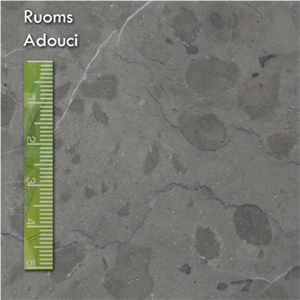
Pierre de Ruoms / Pierre de Labeaume Sedimentary rock. Brecciated limestone, pseudo-compact, with very fine brown and gray grains. The characteristic brecciated appearance manifests as irregular brown ranges, punctuated with small gray to bluish spots.


 France




 Italy




 Portugal

 Spain

 Belgium


 Norway

 Croatia

 Bulgaria

 China

