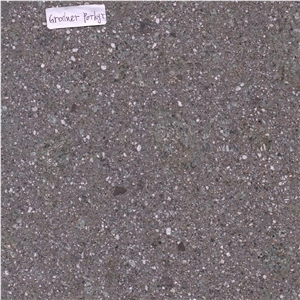
Origin: Eisacktal Valley, South Tyrol Surface: sanded, polished, honed, flamed, flamed and brushed Description: Brixen Granite is one of the most tradition-steeped natural stones in South Tyrol. Thanks to its frost-resistant and robust characteristics it has always been used for building structures (floors, stairs, large steps, stone veneer, bricks), wells or other larger compositions. Granite is an intrusive rock (pluton) that originates below the surface of the earth as a result of magma solidification (igneous rock). Hence, like porphyry, granite is a magmatic rock. The difference in their formation lies in their cooling rates. While porphyry cools quite rapidly at the surface (volcanic eruptions), granite cools significantly slower at a subsurface depth of 2 km. Thus, crystals have more time to develop and are thus bigger, resulting in a clear and ordered structure. Use: This stone is frost-resistant and versatile, thus can be used for a variety of purposes such as for steps, window sills, floor covering and fountains. Mining: Brixen Granite is a native of the Eisacktal valley: it was found here, retrieved here through excavation and is used here a great deal. This stone is not mined in a quarry, thus goes by definition of a boulder rock. Availability: Raw panels at 1.5 * 1.85 m, thickness: 2 and 3 cm currently in stock. Contact us for other sizes
Related products from this supplierRelated Granite Tiles & Slabs products from this supplier
The landscape of South Tyrol is marked by contrasts. In a small space many rocks meet. The African tectonic plates meets here on the European and slides over it, the Alpine fold, by pressure, heat, erosion grew and grow new stones. e.g. crystallized million years ago 290 10 km depth granites from which especially in the area of the Tauernfensters (Ahrntal) were uncovered in the course of time, a very pronounced volcanism started before 280 million years ago and the Bolzano porphyry plate originated. The limestone formations of the Schlern are one of the best preserved reef structures of the primordial ocean world. Again and again this area was flooded by seas and through erosion and deposition sedimentary rocks are formed. Floods have cut deep valleys into the landscape and modeled the Dolomites. Gneisses, basalts, porphyries, marbles, serpentinites, quartzites, granites and sandstones, variously in color and texture, were side by side exposed. This landscape is our inspiration. Let yourself be inspired.


 China
 Italy Mezzaselva



 Spain
 15YR


 Brazil

 India