Origin and Composition:
- Origin: Hellín, Albacete, Castile-La Mancha, Spain
- Formation: This fossiliferous limestone formed in a marine environment, emerging through the compaction of calcium carbonate and organic matter over millennia.
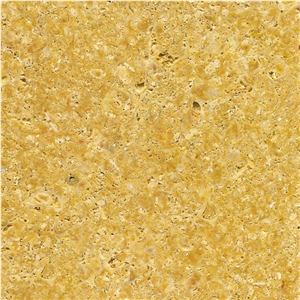
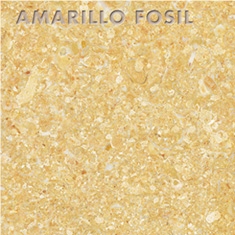
- Appearance: Warm, golden-yellow background, occasionally adorned with pink veining or shadows. It is celebrated for its visible marine fossils, including shell fragments, which grant the stone a distinctive texture and aesthetic.
Physical and Mechanical Properties:
- Water Absorption: 2.2% by weight
- Density: 2380 kg/m³
- Flexural Strength: 9.13 MPa
- Compressive Strength: 53.7 MPa
- Hardness: Generally medium, typical of limestone, making it workable yet durable.
- Porosity: Moderate, as indicated by its water absorption rate.
- Slip Resistance: Varies based on surface finish; more textured finishes offer better slip resistance.
Chemical and Mineral Composition (% by weight):
- Calcium Carbonate (CaCO₃): Predominant component, typically over 90%
- Magnesium Carbonate (MgCO₃): Present in smaller quantities
- Additional Trace Elements: Including silica and iron oxides, contributing to color variations and veining
Uses:
- Architectural Applications: Widely used in flooring, cladding, and wall coverings due to its warm, inviting color and unique fossil patterns.
- Interior Design: Commonly utilized for countertops, staircases, and decorative elements.
- Exterior Applications: Suitable for facades and outdoor paving, given proper maintenance to counteract weathering.
Maintenance:
- Cleaning: Use of pH-neutral cleaners to preserve the surface and minimize etching or damage.
- Sealing: Regular sealing recommended to minimize water absorption and staining.
- General Care: Avoid exposure to acidic substances and abrasive cleaners.
Surface Finish Options:
- Polished: Enhances the stone’s color and texture, giving it a high-gloss, reflective surface.
- Honed: Provides a smooth, matte finish, reducing gloss and glare.
- Brushed: Softens the surface to create a textured, aged appearance.
- Tumbled: Adds an antique, weathered look, increasing slip resistance and texture.
The unique characteristics of Amarillo Fosil Limestone make it a favored choice for those seeking to incorporate natural, historical texture into their spaces, underscored by its versatile applications and appealing aesthetic.
Amarillo Fosil is a calcarenite stone, very homogeneous in structure. It features a soft yellow tone with subtle pinkish shades and is composed of fossil fragments with a predominantly carbonate base and a travertine-like texture. It is ideal for exterior applications and, due to its particular porosity, can be easily installed using traditional cement mortar and putty. It may also be installed with mechanical fixing systems without compromising its strength. It withstands sudden temperature changes, helping to prevent structural damage, cracks, or fissures.
Technical Properties
- Specific Gravity: 2.38 g/cm³
- Water Absorption Coefficient: 2.20%
- Compressive Strength: 537.64 kg/cm²
- Flexural Strength: 91.29 kg/cm²
- Abrasion Resistance: 11.72 mm
- Impact Resistance: 22 cm
- Freeze–Thaw Coefficient: 0.05%


 Spain
 10YR

 China




 Israel

 France

 India

 Morocco


 Croatia

 Norway


 Bulgaria


