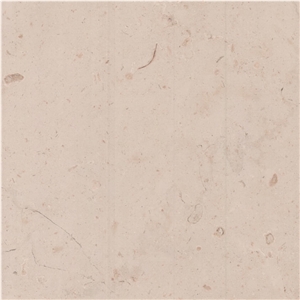
Codacal Real Limestone is a fine-grained, light cream to beige colored natural limestone. It presents a homogeneous and uniform texture with minimal visible fossils or veins, offering a clean and consistent surface appearance. The tone is soft and neutral, making it highly versatile for both traditional and modern architecture.
Texture & Pattern:
Texture: Fine-grain
Pattern: Subtle, occasionally showing micro-fossils under close inspection, otherwise extremely uniform with barely perceptible movement or shading.
Surface Feel: Smooth, slightly warm to the touch when honed or polished.
Microscopic Properties:
Calcite content: 100% (This indicates high purity, resulting in a consistent light tone and good polishing behavior.)
Physical-Mechanical Properties:
- Bending Strength...108 Kg/cm²
- Compression Breaking Load after Freeze-Thaw (FT)...555 Kg/cm²
- Compression Breaking Load (Normal)...550 Kg/cm²
- Volumetric Weight (Density)...2346 Kg/m³
- Water Absorption...5.12 %
- Apparent Porosity...12.03 %
- Thermal Linear Expansion Coefficient...5.7 × 10⁻⁶ /°C
- Abrasion Resistance...5.9 mm (measured as material loss)
- Impact Resistance...35 cm
- Hardness - Mohs Scale: Estimated around 3-4, typical of limestones. (Medium soft stone; susceptible to scratching from harder materials.)
Chemical Composition (% by weight):
- CaCO3 (Calcium Carbonate)...~98–99%
- MgCO3 (Magnesium Carbonate)...<1%
- SiO2 (Silica)...Trace amounts
- Fe2O3 (Iron Oxide)...Very minimal (traces, giving slight warm hue)
- Al2O3 (Aluminum Oxide)...Trace amounts (Because it's 100% calcite under microscopy, impurities are extremely low.)
Typical Usage:
- Interior Wall Cladding
- Flooring (light to moderate traffic areas)
- Bathroom Vanity Tops
- Fireplace Surrounds
- Columns and Balustrades
- Interior Staircases
- Window Sills
- Exterior Cladding (only when properly protected against water infiltration)
Maintenance:
Sealing is recommended after installation, especially for wet areas or floors.
Regular cleaning with neutral pH stone cleaners.
Avoid acidic or harsh chemical cleaners (can etch the calcite).
Periodic resealing (every 1–2 years depending on traffic and usage).
Soft brush or cloth recommended for routine maintenance to preserve the finish.
Available Cutting Sizes:
Tiles:
- 30×30 cm (12"×12")
- 40×40 cm (16"×16")
- 60×60 cm (24"×24")
- 40×60 cm (16"×24")
Slabs:
- 2 cm (¾") and 3 cm (1¼") thickness available
- Slab dimensions usually around 250-280 cm × 140-160 cm
- Custom cut-to-size available for projects (staircases, countertops, wall panels).
Surface Finishes:
Honed (matte, smooth, elegant)
Polished (high-gloss, enhances beige tones)
Brushed (aged and textured, slightly slip-resistant)
Sandblasted (fine rough texture, good for exterior use)
Tumbled (antiqued look, soft edges for rustic designs)
Summary of Strengths:
Very clean and elegant appearance. Good mechanical resistance for indoor use. Easy to work and shape. Warm tone suitable for a variety of designs. High calcite purity assures excellent polishability


 Portugal


 Saudi Arabia

 Germany

 Spain


