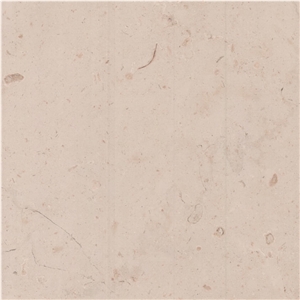
Cottonwood Bottom Ledge Limestone is a light, creamy beige limestone with soft darker hues. It is quarried in Kansas, United States, and is known for its subtle color variations and elegant appearance, making it suitable for various architectural and design applications.
Physical and Mechanical Properties:
- Water Absorption: 8.31%
- Density: 2110 kg/m³
- Flexural Strength:731 Psi (Dry, Parallel to Rift)
- Compressive Strength:5,509 Psi (Dry, Parallel to Rift)
- Hardness: Details on exact hardness may not be specified, but as a limestone, it generally has a Mohs hardness of around 3-4.
- Porosity: Limestone of this type commonly has medium porosity. Exact porosity measures depend on quarry specifics.
- Slip Resistance: Slip resistance can vary based on surface finish but generally provides moderate slip resistance when honed or polished.
Chemical and Mineral Composition (% by weight):
Typically, the exact chemical composition can vary based on the specific quarry, but limestone primarily consists of:
- Calcium Carbonate (CaCO₃): Typically around 90% or more.
- Other common components may include traces of:
- Silica (SiO₂)
- Alumina (Al₂O₃)
- Iron Oxides (Fe₂O₃)
Usage:
Cottonwood Bottom Ledge Limestone is commonly used for:
- Exterior Cladding: Due to its durability and aesthetic appeal.
- Interior Flooring and Wall Cladding: Offers an elegant look for interiors.
- Monuments and Sculptural Elements: Takes well to carving and detailed work.
- Paving and Walkways: Suitable if polished or honed.
- Countertops and Vanity tops: When properly sealed and maintained.
Maintenance:
- Regular cleaning with mild detergents.
- Periodic sealing may be needed to protect against staining and moisture.
- Avoid harsh chemicals or acidic solutions that may etch the stone surface.
Cutting Sizes (in cm):
- Commonly available in:
- Tiles: 30x30, 30x60, 60x60
- Slabs: Custom dimensions upon request
Available Surface Finish Options:
- Polished: For a glossy finish that highlights the natural color variations.
- Honed: A matte finish that is smooth but not reflective.
- Brushed or Antiqued: Offers a more textured surface.
- Sandblasted: Provides a rougher, non-slip surface.
- Tumbled: For a more aged, rustic appearance.
This limestone variant is valued for specialty projects where color consistency, durability, and aesthetic versatility are prioritized. Its properties make it a versatile choice for both residential and commercial applications.


 United States


 Saudi Arabia

 Germany

 Spain

 Portugal


 Norway

 Croatia

 Bulgaria

 China

 France
