


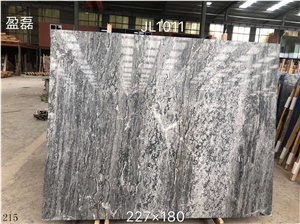
Iran Gray Waves Deep Sea Waves Iran Black Onyx
 9YR

 China


 Iran
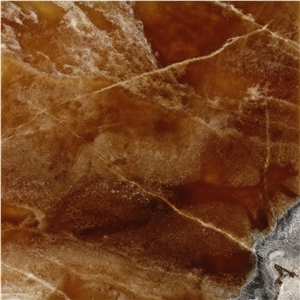
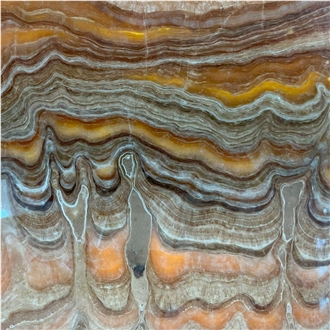
Deep Sea Black Onyx features a distinctive combination of muted greyish-green, sage and olive tones, creamy beige bands, and sharply contrasting reddish-brown, copper and dark amber veins. Despite its name, the stone is not uniformly black; its appearance is defined by layered oceanic depth and rich natural color variations. The interplay of earthy tones creates a dramatic yet elegant decorative surface. Its natural translucency allows light to pass through selected areas, enhancing the depth and character of the stone.
The stone displays prominent horizontal and undulating stratified layers with a fibrous, crystalline structure characteristic of decorative onyx. Wavy, ribbon-like contours run across the surface, creating flowing patterns and a sense of movement. Natural fissures, darker mineral-filled lines and localized crystalline clusters add further visual complexity. The surface can be polished to a smooth finish, although fine polishing marks and natural structural features may remain visible.
Pattern: Distinctive horizontal, wavy and layered formations.
Veining: Irregular reddish-brown, copper and dark amber veins intersect the greyish-green and creamy beige bands.
Texture: Fine-grained to crystalline, with fibrous and locally translucent areas.
Variation: Each slab may display different band widths, color distribution, vein density and crystalline formations. Bookmatching can create striking symmetrical patterns.
The following figures are indicative estimates for preliminary database reference only. They are not certified test results for this specific quarry material.
|
Property |
Indicative Value |
|---|---|
|
Bulk Density |
2,680–2,720 kg/m³ |
|
Water Absorption |
0.15–0.45% |
|
Apparent Porosity |
0.30–1.50% |
|
Compressive Strength |
60–80 MPa |
|
Flexural Strength |
7–10 MPa |
|
Abrasion Resistance |
15–30 mm |
|
Mohs Hardness |
3–4 |
|
Open Porosity |
0.30–1.50% |
Indicative composition by weight; actual mineral proportions and chemistry require laboratory analysis.
|
Component |
Estimated Content |
|---|---|
|
Calcium Carbonate (CaCO₃) |
90–98% |
|
Magnesium Carbonate (MgCO₃) |
0–3% |
|
Silica (SiO₂) |
0.5–4% |
|
Iron Oxides (Fe₂O₃) |
0.2–2% |
|
Aluminium Oxide (Al₂O₃) |
0–1% |
|
Other Mineral Impurities |
0–2% |
The stone is expected to be predominantly calcite-based, with possible aragonite and minor mineral impurities contributing to its coloration and crystalline features. The reddish-brown and amber tones may be associated with iron-bearing minerals.
Deep Sea Black Onyx is primarily suitable for decorative and interior architectural applications, including:
Feature walls and decorative wall panels
Backlit wall installations and illuminated partitions
Luxury bathroom walls and vanity surrounds
Reception desks and decorative furniture
Fireplace surrounds in suitable low-heat applications
Decorative tabletops and countertops with appropriate protection
Bookmatched feature installations and bespoke interior designs
Deep Sea Black Onyx is relatively soft and sensitive to acids, scratching and impact. Use pH-neutral stone cleaners and a soft cloth for routine cleaning. Avoid vinegar, lemon juice, acidic detergents, abrasive pads and harsh chemicals. Apply a suitable penetrating sealer to reduce staining, following the manufacturer's recommendations. Because of its natural fissures and crystalline structure, careful handling, professional installation and appropriate reinforcement are recommended. For countertops and other frequently used surfaces, use protective coatings and avoid direct contact with hot cookware.

 Turkey
Turkey
Turkey

Iran

Turkey

 Peru

Iran

China

 Kyrgyzstan

 India

Turkey

Iran