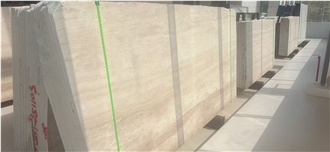
Travertino Romano Classico Chiaro features a warm beige to light tan background with creamy golden undertones. Its natural coloration ranges from pale ivory and soft cream to honey beige and deeper tan, creating a warm, elegant appearance characteristic of classic Roman travertine.
Texture & Structure
This stone has a naturally porous, vacuolar structure formed by mineral deposition and gas cavities during its formation. Its texture is generally compact between the pores, with visible small cavities and natural variations. Depending on the processing, the surface can be left unfilled for a more rustic appearance or filled and honed or polished for a smoother finish.
Pattern & Veining
Its defining feature is distinct horizontal and gently undulating layered banding, with subtle tonal variations ranging from pale ivory to deeper tan. The linear, sedimentary patterns create a natural stratified appearance. Depending on the cutting direction, the material may display pronounced parallel bands or a more clouded, irregular pattern. Individual slabs vary naturally.
Technical Characteristics & Test Results
|
Property
|
Test Result
|
|
Petrographic Classification
|
Vacuolar Limestone
|
|
Unit Volume / Apparent Density
|
2473 kg/m³
|
|
Water Absorption
|
0.80%
|
|
Simple Compressive Strength
|
109 MPa
|
|
Compressive Strength After Freezing
|
110 MPa
|
|
Tangent Elastic Modulus
|
61,800 MPa
|
|
Indirect Tensile Strength (Flexural)
|
13.1 MPa
|
|
Abrasion Coefficient (Granite St. Fedelino Reference)
|
0.38
|
|
Impact Resistance (Minimum Drop Height)
|
36 cm
|
|
Linear Thermal Expansion Coefficient
|
4.6 × 10⁻⁵ °C⁻¹
|
Hardness
A verified Mohs hardness value has not been provided. Travertine is primarily calcite-based and typically has a Mohs hardness of approximately 3. This is a general mineral reference, not a stone-specific laboratory measurement.
Mineralogical Composition
The stone is petrographically classified as vacuolar limestone. Its exact mineralogical composition and percentages by weight have not been provided. Calcite is generally the principal mineral in travertine, while minor amounts of other minerals may occur. Quantitative mineralogical analysis is required to establish the actual proportions.
Chemical Composition
Verified chemical composition percentages by weight are not available. A laboratory analysis would be required to determine the concentrations of CaO, MgO, SiO₂, Fe₂O₃, Al₂O₃, and other oxides. No specific percentages are assumed.
Recommended Applications
Suitable for interior and exterior flooring, wall cladding, façades, bathrooms, vanity tops, staircases, fireplace surrounds, columns, architectural details, and decorative features. It is particularly suited to projects seeking a warm, classic Mediterranean or Roman aesthetic.
For exterior applications, the stone's porosity and freeze-thaw performance should be carefully considered, especially in climates with repeated freezing conditions. Filling, sealing, and appropriate installation methods are recommended according to the intended application.
Maintenance
Clean regularly using a pH-neutral stone cleaner and a soft cloth or mop. Avoid acidic products, including vinegar, lemon-based cleaners, and descalers, as they can etch the calcite surface. Apply a suitable penetrating sealer to help reduce water and stain absorption. Depending on the finish and application, periodic resealing may be necessary. Filled surfaces may require occasional maintenance to preserve the appearance of the pore filling.
Technical test data attributed to the University of Pisa and Politecnico di Torino. Mineralogical and chemical percentages and stone-specific Mohs hardness have not been supplied.


 Italy

 16YR


 China


 Mexico

 Morocco


 Turkey


 Pakistan


 Afghanistan

 Thailand
