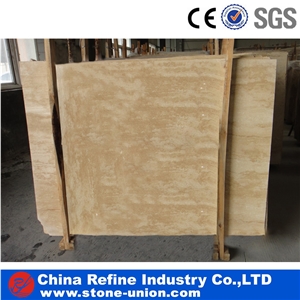
Travertino Romano Oniciato

About
Item Details
- Material Type:
- Travertine
- Origin:
Italy (Tivoli and Guidonia Montecelio, Provincia di Roma, Lazio) - Primary Color(s):
- Beige
- Recommended Usage:
- Kitchen and bathroom countertops, building stone, ornamental stone, stairs, interior wall and floor applications, mosaic, waterjet pattern, wall panels, table tops, interior window parapets, columns, fireplaces surround
- Additional Names:
- Travertino Cristalizado, Romano Traverine, Roman Traverine, Travertino Romano, Travertino Classico, Lapis Tiburtinus, Tibur Stone, Oniciato Bianco Travertine, Bianco Oniciato Travertine, Travertino Bianco Oniciato, Travertino Romano Oniciato
- Finished Surface:
- Polished,Bush Hammered,Tumbled,Brushed,Honed,Split,Machine Cut,Natural Surface,Sandblasted,Combed,Leathered,Water Jet,Filled,Chiseled,Pickling
Testing
- Water Absorption:
- 0.73%
- Density:
- 2435 kg/m3
- Flexural Strength:
- 14.3 MPa
- Compressive Strength:
- 113 MPa
Description
Travertino Romano Oniciato is a classic and elegant natural stone known for its light beige color, characterized by soft ivory waves and veins. This travertine features a distinctive vein-cut surface, where earth gray straight veins create a linear and sophisticated pattern. Quarried in the regions of Tivoli and Guidonia Montecelio, approximately 25 km east of Rome, this stone carries a sense of historical significance and timeless beauty. The subtle interplay of beige and ivory tones, along with the gray veins, makes it a versatile choice for both traditional and contemporary architectural designs.
Petrographic definition: limestone vacuolar
Massa Unit Volume: 2435 kg/m3
Water Absorption: 0.73 %
Breaking Load Compression Simple: 113 MPa
Compression breaking load after freezing: 111 MPa
Tensile indirectly by bending 14.3 MPa
Its coefficient of Abrasion (referred to Granite St. Fedelino): 0.72
Impact resistance: minimum fall height: 29 cm
Linear thermal expansion coefficient of 6.0 x 10⁻⁵ 0C-1
Knoop microhardness: 1324 MPa
Index unevenness of hardness: 1.66
Source: Università di Pisa - Politecnico di Torino


9YR