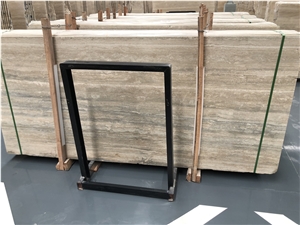
Travertino Romano Silver is a distinguished type of travertine quarried in the Bernini Quarry in Guidonia Montecelio, near Rome, Italy. This travertine is known for its elegant appearance, featuring a range of colors from light gray to silver-gray with subtle variations of white, beige, brown, and sometimes bluish tones. The stone is characterized by its vein-cut, linear veins ranging from silver-gray to dark gray. Below is an in-depth look at its properties, composition, usage, and other relevant details:
Physical and Mechanical Properties
- Water Absorption:Typically around 2% to 3%.
- Density:Approximately 2,500 kg/m³ (kilograms per cubic meter).
- Flexural Strength:Ranges from 7 MPa to 12 MPa (megapascals).
- Compressive Strength:Typically between 70 MPa to 110 MPa.
- Hardness:Mohs scale rating of 3-4.
- Porosity:Porosity is moderate, typical for travertine, which influences its water absorption rate.
- Slip Resistance:Depends on the finish; honed and filled surfaces generally offer moderate slip resistance, while polished finishes may be more slippery when wet.
Chemical and Mineral Composition
- Calcite (CaCO₃):Predominantly, around 95% to 99%.
- Iron Oxides (Fe₂O₃):Trace amounts, providing subtle color variations.
- Quartz (SiO₂):Around 1% to 2%, contributing to the hardness.
- Other Minerals:Trace elements of clay minerals and organic matter which may influence color.
Usage and Application
- Interior Flooring:Popular for its aesthetic appeal in living rooms, hallways, and other indoor spaces.
- Wall Cladding:Frequently used for internal and external walls due to its decorative properties.
- Bathroom and Spa Areas:Used in countertops, shower walls, and floors due to its durability when properly sealed.
- Countertops:Offers a sophisticated look with its unique veining and color palette.
Maintenance
- Sealing:Regular sealing is recommended to protect against staining and water retention.
- Cleaning:Use pH-neutral cleaners; avoid acidic or alkaline substances to maintain surface integrity.
- Polishing:Regular polishing can help maintain its shine, especially for polished finishes.
Cutting Sizes (cm)
- Commonly available in tiles and slabs, such as:
- Tiles: 30x30, 30x60, 60x60.
- Slabs: Custom sizes based on project needs, usually in larger dimensions like 120x240.
Available Surface Finish Options
- Polished:Provides a glossy, reflective finish enhancing the stone's color and veining.
- Honed:Matte finish that gives a more natural look with some slip resistance.
- Brushed:Slightly textured, offering additional grip while preserving visual appeal.
- Tumbled:Offers an antique, rustic appearance with rounded edges and a softer surface.
- Sandblasted:Textured finish that improves slip resistance, ideal for outdoor applications.
Travertino Romano Silver stands out for its elegance and adaptability, making it a favored choice for a variety of architectural and interior design applications. Regular maintenance and proper sealing can enhance its longevity, maintaining both its aesthetics and structural qualities.


 Italy

 2YR

 Spain

 Turkey


 China




 Iran


 Pakistan


 Afghanistan

 Thailand
