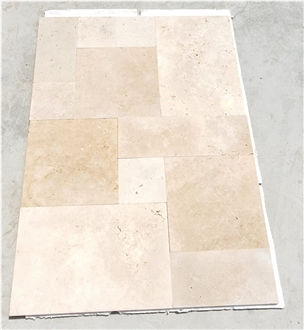
Denizli Travertine is a distinctive natural stone quarried in the Denizli region of Turkey, celebrated for its light classic beige tones and unique formation. This sedimentary rock is composed of calcium-bicarbonate deposits that have been precipitated by hydrothermal waters over time, resulting in a porous and visually striking stone.
The predominant color of Denizli Travertine is a light classic beige, offering a timeless and elegant aesthetic. The subtle variations within this beige palette create a warm and inviting atmosphere, making the stone a versatile choice for a range of design applications.
The porous nature of Denizli Travertine is a notable characteristic, adding to its visual appeal and providing a textured surface. The stone's pores are a result of the mineral deposits and sediments that were deposited by hydrothermal waters. This porous quality gives Denizli Travertine a distinctive tactile quality, contributing to its popularity in both traditional and contemporary design.
Quarried in the Denizli region of Turkey, this travertine holds a special place in the world of natural stone. Its light beige coloration, coupled with its unique porous structure, makes it well-suited for applications such as flooring, wall cladding, and various interior and exterior design elements. Denizli Travertine not only showcases the geological richness of its origin but also offers a touch of classic beauty to spaces that embrace its natural charm.
Hardness (mohs) : 3,5
Unit Volume Weight: (gr/cm3) : 2,41
Density (gr/cm3) : 2,73
Water Absortion at Atmospheric Pressure
by weight (%) : 2,6
by volume (%) : 6,3
Water Absortion at Boiling Water
by weight (%) : 4,0
by volume (%) : 9,5
Prosity: (%) : 6,3
Compressive Strenght: Kgf/cm3 : 500
Compressive Strenght After Freezing:Kgf/cm3 : 520
Strenght to Blow: Kgf/cm3 : 3
Strenght to Bending: Kgf/cm3 : 127
Modules of Elasticity: Kgf/cm3 : 18,46x10⁴
Ratio of Fullnes: (%) : 88,3
Degree of Pores: (%) : 11,7
Avarge Arasion Strenght: (cm3/50cm3) : 54,59
Avarge Tensile Strenght: Kgf/cm2: : 386,26
**
Modules of Elasticity (Kgf/cm2): 5.38x10⁴
Ratio of Fullness (%): 91.9
Degree of Pores (%) : 8.1
Average Abrasion Strength (cm3/50 cm2) : 28.7
Average Tensile Strength (Kgf/cm2) : 41
CHEMICAL ANALYSIS %
SiO2-- 0.26
Fe2O3-- 0.32
CaO-- 54.55
MgO-- 0.31


 Turkey


 15YR




 Italy


 Mexico

 Morocco


 Pakistan


 Afghanistan

 Thailand
