Post Your Needs

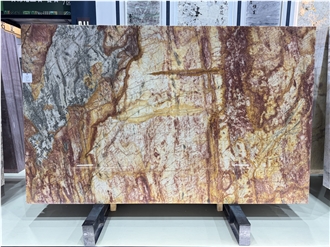
Damask Quartzite

Quartzite

Brazil

About

Item Details

Material Type:
Quartzite
Origin:
Brazil
Recommended Usage:
kitchen and bathroom countertop, wash basins, building stone, ornamental stone, stairs, interior wall and floor applications, mosaic, water-jet pattern, wall panels, table tops, balustrades, columns, fireplaces, luxury furniture
Additional Names:
Damask Red Quartzite
Finished Surface:
Polished,Bush Hammered,Tumbled,Brushed,Honed,Split,Machine Cut,Natural Surface,Sandblasted,Combed,Leathered,Water Jet,Chiseled,Pickling

Testing

Water Absorption:
0.15 – 0.35 %
Density:
2650 – 2680 kg/m³
Flexural Strength:
14 – 16 MPa
Compressive Strength:
160 – 180 MPa

Description

Damask Quartzite is a vibrant and highly exotic natural stone quarried in Brazil, known for its dramatic multicolored veining and striking visual movement. The stone features rich and dynamic tones of red, gold, and white, forming bold natural patterns that create a luxurious and artistic appearance suitable for statement applications. Its surface displays flowing, interwoven veins and crystalline textures typical of high-grade quartzite, giving depth, brilliance, and durability.

Texture & Pattern

Medium to coarse crystalline texture with strong directional veining and multi-layered color flow. Each slab is unique, featuring bold natural patterns in red, gold, ivory, and soft white contrasts.

Technical Test Results

  • Compressive Strength: 160 – 180 MPa
  • Flexural Strength: 14 – 16 MPa
  • Water Absorption: 0.15 – 0.35%
  • Bulk Density: 2.65 – 2.68 g/cm³
  • Hardness Mohs hardness: 7 (Quartzite grade – high resistance to scratching and abrasion)

Chemical Composition (% by weight)

  • SiO₂ (Silica): 92 – 98%
  • Fe₂O₃ (Iron Oxide): 0.5 – 2.5%
  • Al₂O₃: 0.5 – 1.5%
  • Other minerals: trace amounts of feldspar and mica

Mineral Composition (% by weight)

  • Quartz: 90 – 96%
  • Feldspar: 2 – 5%
  • Mica & accessory minerals: 1 – 3%

Usage

Ideal for luxury interior and exterior applications including kitchen countertops, wall cladding, flooring, feature walls, reception areas, hotel lobbies, and high-end commercial projects.

Maintenance

Low maintenance natural stone. Regular cleaning with pH-neutral cleaners is recommended. Avoid acidic or abrasive chemicals. Periodic sealing is advised for enhanced stain resistance and long-term durability.

FAQ

Is Damask Quartzite heat resistant? Is it suitable for use in fireplaces?

Damask Quartzite is generally heat resistant, making it suitable for use in environments exposed to high temperatures, such as fireplaces. Quartzite, in general, is a metamorphic rock formed from sandstone and is known for its hardness and durability, which includes resistance to heat and scratching. However, its important to ensure that the specific type of quartzite you are considering has been properly tested and treated for high-temperature environments, as variations in mineral composition or fabrication methods can affect performance. Consulting with a professional installer or supplier about the suitability of Damask Quartzite for your specific fireplace project is advised to ensure safety and durability.

If I use 1.2 cm thick Damask Quartzite as a table top, will it be strong enough? Will it break easily?

Using 1.2 cm thick Damask Quartzite as a tabletop may present some concerns regarding its strength and durability. Quartzite is a very hard and durable natural stone, often more so than granite, which makes it a good candidate for various applications, including countertops. However, the thickness of the material is an important factor in determining its suitability and durability as a tabletop. Typically, natural stone countertops, including quartzite, are around 2 cm to 3 cm thick to ensure they have sufficient strength and durability. At 1.2 cm, the quartzite slab is quite thin, which could increase the risk of it being prone to cracking, chipping, or breaking, especially if the tabletop is large or subjected to localized pressure or impact. To enhance its strength, the thinner quartzite slab can be supported by a proper substrate, such as plywood, and reinforced around the edges. Additionally, using a good quality sealant can protect the surface from stains and minor damage. Nonetheless, for heavy use scenarios, a thicker slab is advisable. In summary, while 1.2 cm thick Damask Quartzite can be used as a tabletop with proper support and installation, it may not be as robust as thicker options and could be more susceptible to damage, especially in high-traffic or high-use environments. If possible, opting for a thicker slab or considering professional advice or installation would be prudent.

How do I know if my Damask Quartzite is sealed?

To determine if your Damask Quartzite is sealed, you can perform a simple water test. Heres how: 1. **Clean the Surface**: Before testing, ensure that the quartzite surface is clean and dry. 2. **Water Droplet Test**: - Pour a small amount of water (about a tablespoon) onto the surface of the quartzite. - Let it sit for about 15-30 minutes. 3. **Observe the Results**: - **If the Water Beads Up:** If the water remains beaded on the surface and does not absorb into the stone, your quartzite is likely well-sealed. - **If the Water Absorbs or Darkens the Stone:** If the water is absorbed and the area underneath becomes dark, it indicates that the seal has worn off, and its time to reseal the surface. 4. **Check Multiple Areas**: It can be beneficial to test different areas, particularly high-use or high-traffic zones, to ensure the entire surface is adequately sealed. Performing this test periodically will help maintain the beauty and longevity of your Damask Quartzite by ensuring it remains protected from stains and damage.

Do I have to seal Damask Quartzite kitchen countertop every year?

Yes, it is generally recommended to seal Damask Quartzite kitchen countertops annually. Quartzite is a natural stone that is typically more resistant to etching and scratching than marble, but it can still be porous, allowing liquids to penetrate and potentially cause stains. Sealing helps to protect the surface from moisture and stains by creating a barrier. However, the frequency of sealing may vary based on the specific type of quartzite, the quality of the sealant used, and how heavily the countertop is used. To determine if your countertop needs resealing, perform the water test: pour a little water on the surface and see if it beads up or is absorbed. If it is absorbed, its time to reseal. Always follow the manufacturers or installation professionals recommendations for maintaining and sealing your specific countertop.

What does vinegar do to Damask Quartzite countertop?

Vinegar is acidic and can potentially damage a Damask Quartzite countertop, as well as other types of natural stone surfaces. Even though quartzite is generally more resistant to etching and staining than some other natural stones like marble, prolonged exposure to acidic substances like vinegar can dull its finish and possibly cause etching over time. It’s always best to use pH-balanced or neutral cleaners specifically formulated for natural stone surfaces to maintain the beauty and integrity of your quartzite countertop. If vinegar accidentally spills on the surface, it should be wiped up immediately and the area should be cleaned with water and a stone-safe cleaner.

Can I put a cup of tea on Damask Quartzite table top?

Placing a cup of tea on a Damask Quartzite tabletop is generally safe, as quartzite is a highly durable and heat-resistant natural stone. It is less prone to scratching, etching, and staining compared to materials like marble. However, its always a good idea to use a coaster to protect the surface from potential water rings or heat marks. If the quartzite has been properly sealed, it should resist liquid absorption and stains, but regular maintenance is still recommended to keep the surface looking its best.

Products & Prices

Hot Quartzite

New Quartzite

Post Your Request

The request includes:
  1. surface finished, size
  2. quantity required