Post Your Needs

Green Forest Quartzite

Quartzite

Brazil

About

Item Details

Material Type:
Quartzite
Origin:
Brazil
Recommended Usage:
kitchen and bathroom countertop, wash basins, building stone, ornamental stone, stairs, interior wall and floor applications, mosaic, water-jet pattern, wall panels, table tops, balustrades, columns, fireplaces, luxury furniture
Additional Names:
Forest Green Quartzite, Wizard of Oz Quartzite, in China stone market:绿野仙踪 (Lǜ Yě Xiān Zōng), Green Forest Quartzite
Finished Surface:
Polished,Bush Hammered,Tumbled,Brushed,Honed,Split,Machine Cut,Natural Surface,Sandblasted,Combed,Leathered,Water Jet,Chiseled,Pickling

Testing

Water Absorption:
0.15 - 0.40 % by weight
Density:
2700 - 2750 kg/m³
Flexural Strength:
15 - 22 MPa
Compressive Strength:
180 - 220 MPa

Description

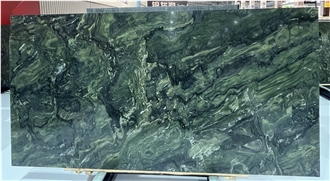
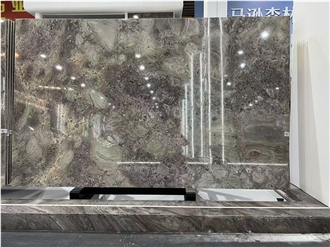
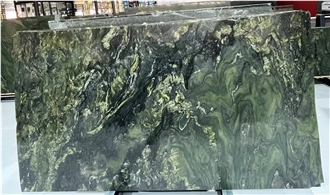
Green Forest Quartzite is a highly expressive natural quartzite quarried in Brazil, distinguished by an exceptionally rich deep moss-green to sage-green background crossed by powerful golden-yellow, ochre and rust-brown streaks. The dramatic veining resembles active lightning bolts, creating strong directional movement across the slab. In some blocks, the stone exhibits significant structural depth, with fine crystalline boundaries visible beneath the dominant gold-veined surface layers.

General Characteristics

  • Base Color: Deep moss green to sage green
  • Secondary Colors: Golden yellow, ochre, rust brown
  • Veining: Strong, jagged, irregular and directional
  • Pattern: Dramatic lightning-bolt movement
  • Texture: Crystalline, compact and granular
  • Structure: Dense metamorphic structure with visible crystalline boundaries
  • Appearance: Luxurious, dramatic and highly decorative
  • Variation: Medium to high, depending on quarry block
  • Recommended Finish: Polished, honed, leathered and other specialty finishes

Texture

Green Forest Quartzite has a dense crystalline texture created by the metamorphic recrystallization of quartz-rich rock. Fine interlocking crystals provide the stone with its characteristic hardness and durability. Some slabs can display subtle crystalline boundaries beneath the dominant green and golden surface pattern, creating a sense of three-dimensional depth. Under a polished finish, these crystalline structures can reflect light and enhance the richness of the green background.

Pattern & Veining

The stone's defining characteristic is its dramatic color contrast. Deep moss and sage green form the dominant background. Golden-yellow and ochre streaks create the primary movement. Rust-brown accents add warmth and additional depth. Veins can be jagged, branching and highly directional. Some sections resemble lightning bolts crossing the slab. Veining intensity and direction can vary substantially between blocks. Large slabs can be particularly effective for bookmatching, where the directional veins create symmetrical or mirrored compositions.

Indicative Physical & Mechanical Properties

The following values are indicative ranges for Brazilian quartzite and should not be considered certified test results for every Green Forest Quartzite block.

  • Apparent Density: 2,700–2,750 kg/m³
  • Water Absorption: 0.15–0.40% by weight
  • Open Porosity: 0.1–1.0%
  • Compressive Strength: 180–220 MPa
  • Flexural Strength: 15–22 MPa
  • Abrasion Resistance: Approx. 10–25 cm³/50 cm²
  • Mohs Hardness: Approx. 6.5–7
  • Freeze-Thaw Resistance: Generally good; project-specific testing recommended

Note: Actual test results can vary according to quarry location, geological formation and individual block. For commercial or architectural projects, request the supplier's current laboratory test certificate for the exact material.

Mineral Composition

Green Forest Quartzite is predominantly composed of quartz with varying amounts of feldspar, mica and other accessory minerals. Indicative mineral composition: Mineral Approx. % by Weight

  • Quartz: 70–90%
  • Feldspar: 3–15%
  • Mica: 2–10%
  • Amphibole / Pyroxene: 0–5%
  • Iron-bearing minerals: 0.5–5%
  • Other accessory minerals: <3%

The green coloration may be associated with chlorite, amphibole, epidote or other green-bearing metamorphic minerals, while the golden-yellow, ochre and rust tones can be related to iron-bearing minerals and alteration zones.

Chemical Composition

Indicative chemical composition: Chemical Component, Approx. % by Weight

  • SiO₂: 70–90%
  • Al₂O₃: 3–12%
  • Fe₂O₃ / FeO: 0.5–6%
  • CaO: 0.2–4%
  • MgO: 0.2–5%
  • K₂O + Na₂O: 1–6%
  • Other oxides: <3%

The actual chemistry may vary considerably because Green Forest Quartzite can contain different proportions of quartz, feldspar, mica and green metamorphic minerals.

Recommended Applications

Green Forest Quartzite is particularly suitable for luxury residential, hospitality and commercial projects, including:

Kitchen countertops, Kitchen islands, Bathroom vanity tops, Feature walls, Interior wall cladding, Luxury flooring, Fireplace surrounds, Reception desks, Hotel and restaurant interiors, Tabletops, Coffee tables, Furniture, Staircases and steps, Decorative panels, Columns, Waterjet designs, Bookmatched feature walls,  High-end architectural installations.

Its high hardness and relatively low water absorption make it particularly attractive for countertops and other high-use interior surfaces.

Exterior applications may be possible depending on the specific material, finish and climate, but project-specific testing is recommended.

Maintenance

Green Forest Quartzite is a relatively hard and durable natural stone, but proper maintenance is still recommended.

  • Apply a high-quality penetrating stone sealer after installation.
  • Use a pH-neutral stone cleaner for routine cleaning.
  • Avoid strong acids and highly alkaline cleaning chemicals.
  • Clean spills promptly, particularly oils, coffee, wine and strongly colored liquids.
  • Use cutting boards and trivets on kitchen countertops.
  • Avoid abrasive powders and aggressive scouring pads.
  • Periodically inspect the sealer and reseal when necessary.
  • For polished surfaces, use non-abrasive cleaning products to maintain the gloss.
  • For exterior applications, follow a maintenance program appropriate to the local climate.

FAQ

Can I use bleach when cleaning a Green Forest Quartzite kitchen countertop?

Using bleach on a Green Forest Quartzite countertop is not recommended. Quartzite is a natural stone that is generally quite durable and resistant to heat and scratches, but it can be sensitive to acidic or harsh cleaners like bleach. These substances can etch the surface or cause discoloration over time. Instead, its best to use a pH-balanced stone cleaner or a mild dish soap mixed with warm water to clean your quartzite countertop. Use a soft cloth or sponge to wipe down the surface, and make sure to rinse thoroughly. Always avoid abrasive cleaners or pads, as they can scratch the stone. Regularly sealing the countertop, following the manufacturers guidelines, can also help protect it from stains and damage.

If I chop meat on a Green Forest Quartzite kitchen countertop, will it leave knife marks?

Green Forest Quartzite is a durable and hard natural stone, typically more resistant to scratching and etching compared to softer materials like marble. However, while it is highly resistant to knife marks, no surface is completely impervious to damage. Repeated cutting and chopping directly on the countertop might eventually lead to visible marks or dull the finish over time. For this reason, its always a good idea to use a cutting board to protect both your knives and the countertop. This will help maintain the appearance and longevity of the countertop and keep your knives sharp.

What does vinegar do to Green Forest Quartzite countertop?

Using vinegar on a Green Forest Quartzite countertop is not recommended. Quartzite is a natural stone that is denser and more durable than marble, but it is still porous and can be sensitive to acidic substances. Vinegar is acidic and can etch or dull the surface of the stone if left in contact for too long. This can cause the countertop to lose its natural shine and may leave unsightly marks or discoloration. To maintain the beauty of a Green Forest Quartzite countertop, its best to clean it with a pH-balanced cleaner or a mild dish soap mixed with warm water. Always use a soft cloth or sponge for cleaning, and make sure to rinse the surface thoroughly with clean water and dry it with a soft towel. Additionally, sealing the countertop periodically can help protect it from stains and damage.

Is 18 mm Green Forest Quartzite good for a commercial bathroom top?

Using 18 mm Green Forest Quartzite for a commercial bathroom countertop can be a good choice, depending on several factors: 1. **Durability:** Quartzite is a hard and durable natural stone, making it suitable for high-traffic areas like commercial bathrooms. Its resistant to scratching and can withstand heavy use. 2. **Aesthetic Appeal:** Green Forest Quartzite has a unique and attractive appearance, which can enhance the overall design of the bathroom. 3. **Stain Resistance:** Quartzite is generally less porous than other natural stones, but it still needs to be properly sealed to prevent staining from soaps, cosmetics, and cleaning agents typically used in bathrooms. 4. **Maintenance:** Regular sealing and proper maintenance are necessary to keep the quartzite looking its best and to ensure its longevity. 5. **Cost Considerations:** While quartzite is often more expensive than other materials, its durability and aesthetic benefits can make it a worthwhile investment for a commercial setting. 6. **Support and Installation:** The 18 mm thickness should provide adequate strength for a countertop, but proper installation, including sufficient support, is crucial to prevent damage. If these considerations align with your project goals, Green Forest Quartzite could be an excellent choice for your commercial bathroom top.

How can I remove a red sauce stain from a Green Forest Quartzite kitchen countertop?

Removing a red sauce stain from a Green Forest Quartzite countertop can be challenging, but with the right approach, you can often restore its appearance. Quartzite is a natural stone, so its important to use methods that wont damage the surface. Heres what you can try: 1. **Blot the Stain**: Quickly blot (dont rub) any excess sauce with a clean, dry cloth or paper towel. This step is important to prevent spreading the stain. 2. **Mild Soap and Water**: Mix a solution of warm water and a few drops of mild dish soap. Dip a soft cloth or sponge into the solution and gently wipe the stained area. Rinse with clean water and dry with a soft towel. 3. **Baking Soda Paste**: Create a paste using baking soda and a small amount of water. Apply it to the stained area, covering it completely. Let it sit for 15-30 minutes—this helps to lift the stain without scratching the surface. Gently wipe away with a damp cloth, rinse with water, and dry. 4. **Hydrogen Peroxide**: For tougher stains, you can use a solution of hydrogen peroxide. Dampen a cloth with hydrogen peroxide and place it over the stain. Let it sit for a few hours or overnight if needed. Be sure to test this on an inconspicuous area first to ensure it doesn’t discolor the quartzite. 5. **Stone Cleaner**: Use a stone-specific cleaner that is safe for quartzite. These products are designed to clean while maintaining the integrity of the natural stone. 6. **Poultice**: In some cases, a commercial poultice powder (available at stone supply stores) designed for quartzite can be effective. Follow the instructions on the product to apply the poultice to the stained area. This usually involves applying the powder, covering it with plastic wrap, and leaving it to extract the stain from the stone. 7. **Sealing**: If your quartzite countertop isn’t already sealed, consider applying a high-quality stone sealer once the stain is removed to prevent future stains. Follow the manufacturers instructions for best results. Remember to avoid using abrasive cleaners or tools, acidic substances (like vinegar or lemon juice), or harsh chemicals, as these can damage the quartzite surface. If the stain persists, it might be worth consulting a professional stone care expert.

How can I repair the scratched surface of the Green Forest Quartzite steps?

Repairing scratched Green Forest Quartzite steps involves a few careful steps to restore the surface and maintain its natural beauty. Heres a general guide on how to do it: 1. **Clean the Surface**: - Start by thoroughly cleaning the quartzite surface to remove any dirt, dust, or debris. Use a mild pH-balanced stone cleaner or a mixture of warm water and a few drops of dish soap. Rinse well and let it dry completely. 2. **Assess the Damage**: - Examine the extent of the scratches. Light, superficial scratches can often be treated differently than deeper gouges. 3. **Buffing Out Light Scratches**: - Use a polishing powder specifically designed for quartzite. Make sure it is non-acidic to prevent any damage to the stone. - Apply the powder with a damp, soft cloth or a buffing pad attached to a low RPM hand polisher machine. Rub gently in a circular motion until the scratch appears less visible. Always follow the instructions on the products label. - Rinse and wipe the area with clean water after buffing. 4. **Filling Deeper Scratches or Gouges**: - If the scratches are deeper, you might need a stone repair kit. - Mix an epoxy resin or marble repair compound that matches the color of your quartzite. Follow product instructions for mixing and application. - Apply the mixture to the scratch with a small putty knife or wooden applicator, pressing it into the scratch. - Allow it to cure as per the products instructions, then gently sand the repair area with a fine-grit sandpaper (often included in kits) until smooth and level with the surrounding area. - Buff the surface with polishing powder and a soft cloth to achieve a uniform finish. 5. **Seal the Quartzite (Optional)**: - While quartzite is relatively hard and resistant to etching, sealing can help prevent future damage and staining. - Use a high-quality stone sealer appropriate for quartzite, following the manufacturers instructions. 6. **Regular Maintenance**: - Clean the steps regularly with gentle cleaners. - Avoid abrasive cleaning tools or harsh chemicals that can damage the stone. - Place mats or rugs on the steps to minimize direct contact and potential scratching. If youre not confident in repairing the scratches yourself, or if they are particularly severe, consider consulting a professional stone restoration expert. They have the tools and expertise to restore your quartzite steps to their original condition.

Products & Prices

View More

Hot Quartzite

New Quartzite

Post Your Request

The request includes:
  1. surface finished, size
  2. quantity required