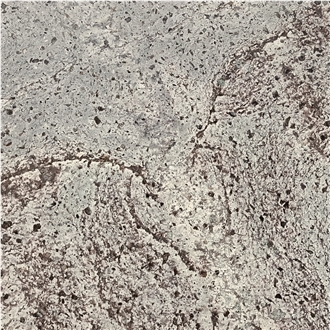
Porfido Valcamonica is a high-quality rhyolitic ignimbrite, commonly referred to as porphyry, exclusively quarried by the Pedretti family in the Adamello Brenta Natural Park, Italy. This unique stone is renowned for its exceptional durability, natural slip resistance, and striking speckled appearance, featuring grey, brown, and white mineral crystals embedded in a dense matrix. The Pedretti company, with a heritage dating back to the early 1900s, utilizes a blend of traditional craftsmanship and advanced technology to produce slabs and tiles suitable for various high-traffic applications.
Physical and Mechanical Properties
- Water Absorption: 2.0% by volume
- Density: 2665 kg/m³
- Flexural Strength: 29.5 MPa
- Compressive Strength: 296.0 - 323.0 MPa
- Hardness: High durability, highly scratch-resistant
- Porosity: Low, contributing to its density and strength
- Slip Resistance: Excellent, making it ideal for both interior and exterior flooring
Chemical and Mineral Compositions (by weight %)
- Silica (SiO₂): Major component, providing hardness and durability
- Aluminum Oxide (Al₂O₃): Enhances the stone's resistance to weathering
- Iron Oxides (FeO, Fe₂O₃): Contributes to the stone's coloration
- Potassium Oxide (K₂O) and Sodium Oxide (Na₂O): Present in smaller quantities, contributing to the stone's overall matrix structure
Usage
- Monumental Projects: Ideal for use in significant architectural and commemorative structures
- Urban Paving: Suitable for public squares, walkways, and pedestrian zones
- Architectural Cladding: Used for both aesthetic and protective purposes on building exteriors
- Interior Applications: Including flooring and feature walls in high-traffic areas
Maintenance
- General Cleaning: Regularly cleaned with water and neutral pH cleaners
- Stain Removal: Consult with professionals for appropriate stain removal processes
- Sealing: Although the porosity is low, sealing may be recommended for enhanced protection and longevity
Cutting Sizes (cm)
- Commonly available in custom dimensions based on project specifications
- Typical sizes include:
- Tiles: 30x30, 30x60, 60x60
- Slabs: Standard thickness ranging from 2-10 cm
Available Common Surface Finish Options
- Natural Cleft: Retains the stone's natural texture and grip
- Honed: Smooth and matte finish that brings out the stone's inherent colors and patterns
- Polished: Offers a reflective surface for a more refined appearance in specific applications
- Bush-Hammered: Provides a textured surface with enhanced slip resistance
Porfido Valcamonica, with its unique characteristics and historical significance, remains a sought-after material in both traditional and contemporary design due to its functionality, aesthetics, and the sustainable practices pursued by the Pedretti family in its extraction and processing.
- Petrographic Definition: Rhyolitic Ignimbrite
- Unit Mass Volume: 2,665 kg/m³
- Water Absorption: 0.21%
- Compressive Strength (Simple Breaking Load): 323 MPa
- Compressive Strength After Freezing: 325 MPa
- Indirect Tensile Strength (Flexural): 29.5 MPa
- Relative Abrasion Coefficient (vs. Granite St. Fedelino): 2.50
- Impact Resistance (Minimum Drop Height): 66 cm
- Linear Thermal Expansion Coefficient: 6.3 × 10⁻⁵ °C⁻¹
Source: Politecnico di Milano


 Italy


 Czech Republic


 Argentina


 China



 Iran

